Episode Transcript
[00:00:04] Speaker A: Hello.
[00:00:05] Speaker B: Hi.
[00:00:07] Speaker A: All right, so what have we learned then over the past almost six years? What have we learned? Let me ask you. What happens to everyone if they get old enough?
[00:00:18] Speaker B: They die.
[00:00:19] Speaker A: Yes. Assuming that you don't die of any other factors.
[00:00:24] Speaker B: Gotcha.
[00:00:25] Speaker A: What are you gonna get eventually? You're gonna get cancer, aren't you?
[00:00:28] Speaker B: Yes.
[00:00:30] Speaker A: We've many a time discussed the biological inevitability of cancer. And in. In practically every case you can.
You can think of it almost like a closed loop of cancer. It's something that you develop. It's something your body develops, a mutation that divides and grows and proliferates and ends up causing drama that kills you.
[00:01:00] Speaker B: Yes, drama that kills you. I like that.
[00:01:03] Speaker A: Internal drama, right?
[00:01:05] Speaker B: Yeah. All kinds of. All kinds of drama going on in there.
[00:01:08] Speaker A: And, you know, so many different varieties, so many different types. But as we've discussed plenty of times before, pretty much inevitable for anyone past a certain age. You keep going. You keep going. If you dodge any other way of dying, it'll get you in the end.
[00:01:25] Speaker B: Yes.
[00:01:26] Speaker A: But think of this closed loop that I talk about. Think of. Think of cancer as being, as far as, you know, as our general understanding is that it's something that comes from you and dies with you.
[00:01:40] Speaker B: Okay. Yeah.
[00:01:40] Speaker A: You know what I'm saying? It's something that you both.
[00:01:43] Speaker B: Something going on in your own cells, a closed loop.
[00:01:47] Speaker A: Something that you. That then dies alongside you and is of you and ends of you. Okay.
Okay. Okay. Okay. Okay. Interesting. Interesting. So why don't you come with me to 1996? Right.
[00:02:00] Speaker B: Alrighty.
[00:02:01] Speaker A: Why don't you come with me to 1996 and. Why don't you come with me to Tasmania?
[00:02:06] Speaker B: Can I just real quickly say that because of, like, when I started learning Spanish, there are certain years that like, trigger me to immediately translate them into Spanish, and 1996 is one of those. As soon as you.
[00:02:21] Speaker A: How is that?
[00:02:22] Speaker B: Because of. Because that's when I started learning Spanish.
[00:02:25] Speaker A: So what is 1996 in Spanish then? Come on, you. Obviously.
There you go. Good.
[00:02:31] Speaker B: But it's just like my brain immediately does it and it's like really hard not to say it out loud. As soon as you say 1996, my
[00:02:37] Speaker A: brain is just delighted to help you get that out of your system.
[00:02:41] Speaker B: Thank you. Thank you for letting me do that. Go on. What happened in Milovicier?
[00:02:46] Speaker A: In Tasmania?
[00:02:47] Speaker B: In Tasmania.
[00:02:49] Speaker A: In Tasmania, in 1996, if I ask you to tell me what is the animal species that you associate with Tasmania
[00:02:57] Speaker B: the most, you would say Tasmanian devil.
[00:03:00] Speaker A: Correct.
You would say The Tasmanian devil. So in 1996, a wildlife photographer, a Dutch photographer by the name of Christo Bars B A A R s was photographing Tasmanian devils in the northeastern corner of Tasmania, an area, an area known as Mount William.
[00:03:23] Speaker B: What a job.
[00:03:25] Speaker A: What a beautiful, beautiful, beautiful job photographing Tasmanian doubles.
[00:03:29] Speaker B: Oh, there's nonetheless. Okay. Got ahead of myself.
[00:03:32] Speaker A: Came across this.
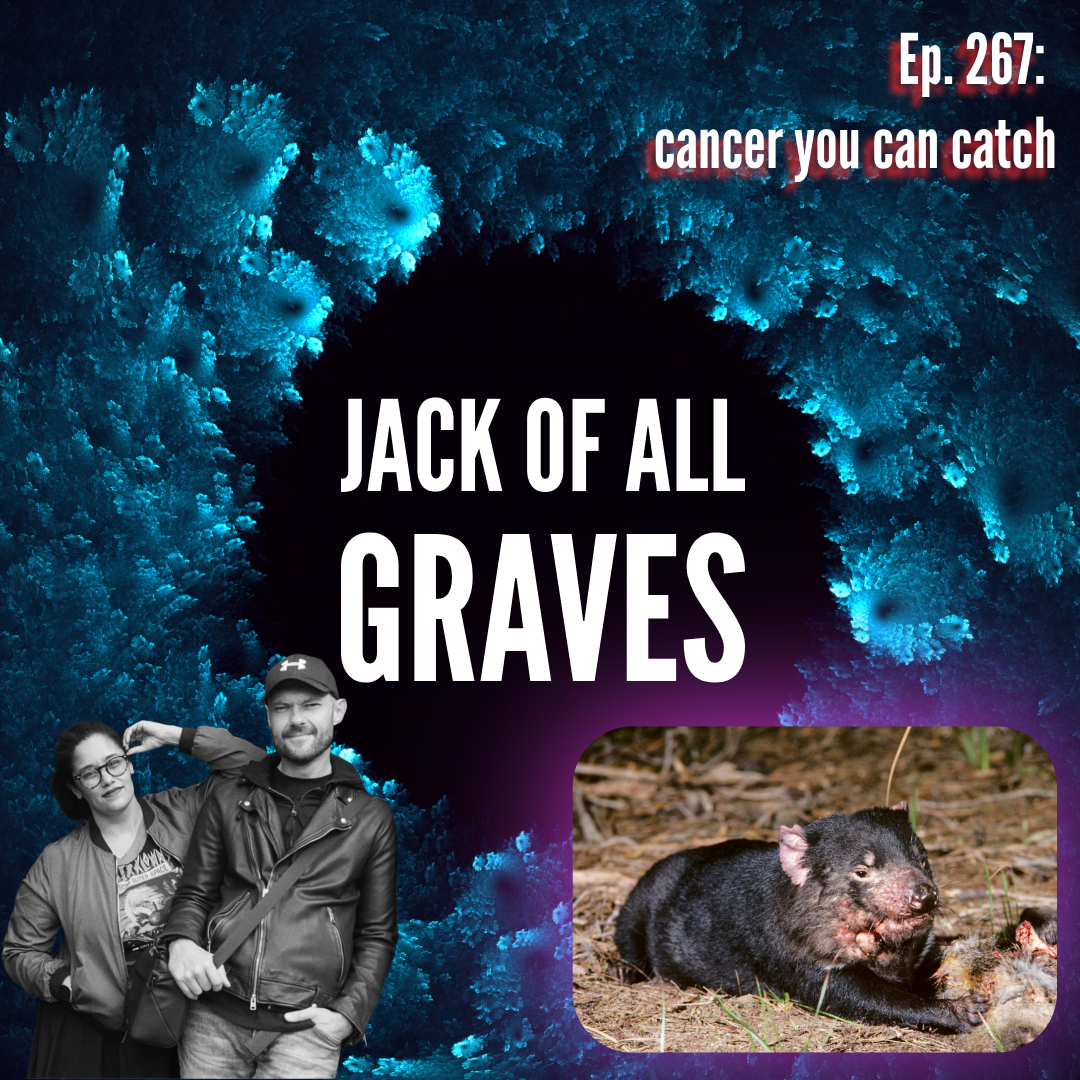
Check your signal. I've just sent you a little photo which I'd love you to describe.
[00:03:39] Speaker B: Huh?
[00:03:40] Speaker A: Yeah.
[00:03:41] Speaker B: What in the.
Okay, we have some sort of.
It's a Tasmanian devil. Right. That is what that is. Right. But it seems to be like have a growth of some kind, as if it's like twin is coming out of its face and then is it eating another Tasmanian devil?
[00:04:03] Speaker A: No, no, it is not. That is a. You've beautifully described that. A disfiguring tumescent kind of growth on the face. Yes.
[00:04:13] Speaker B: Yep.
[00:04:14] Speaker A: It is raw looking. It is cauliflower esque, it is garish.
And so unusual was that growth that when bars took those photos and noticed
[00:04:30] Speaker B: this,
[00:04:32] Speaker A: the photographer Christo made sure to go out of his way to make sure that the photos were seen by the scientific community within Tasmania. Right.
[00:04:42] Speaker B: What is it eating?
[00:04:44] Speaker A: The, the Tasmanian devil in that photo you've just seen there is eating nothing.
[00:04:49] Speaker B: What's in front of it?
[00:04:51] Speaker A: Lumps.
Oh, that's another. Oh, right, okay. On the floor. That's just another animal. Let's just carry on. Okay.
[00:04:58] Speaker B: It looks like it's eating another Tasmanian devil. I guess, you know, your focus was more on the face tumor and I was looking at the bloody disaster in front of it. But okay, maybe not part of the story.
[00:05:10] Speaker A: Maybe, maybe it is. Hold that thought.
So, bars pass these images on to the wildlife authorities, onto the wildlife biology department within the Tasmanian government. Right.
[00:05:25] Speaker B: 10
[00:05:27] Speaker A: bars had never seen anything like this, anything as completely out of the ordinary as these facial lesions. Okay, Right.
And it was quickly assessed that a local demise, a local sharp decline in the Tasmanian devil population was happening around the time that these photos were taken. Right.
This, this disease, these growths, which became known as dftd. Devil Facial tumor disease. Oh yeah.
Was causing a massive drop in the Tasmanian devil population, massive drop in numbers and a lack of healthy adults. Right.
[00:06:19] Speaker B: Right.
[00:06:20] Speaker A: Now, even though it was first photographed in 1996, by the time the world saw those pictures, by the time the scientific community saw those photos, they were already looking at a disease that had been around roughly a decade before it had even been spotted. Right.
[00:06:39] Speaker B: Okay.
[00:06:41] Speaker A: DFTD had been around since estimated around about 1980. 6.
And when researchers started mapping those tuna cells using a process called karyotyping, mapping the chromosomes, mapping the genetic signature of those of those tumors.
Fucking hell. But cancer cells from Tasmanian devils in different locations, different packs, different areas of Tasmania.
But each.
Chew on this. Each of the tumors revealed an absolutely identical karyotype.
[00:07:24] Speaker B: Right? Okay.
[00:07:25] Speaker A: Yeah. The cancer came from a different fucking place to the host. In every case, when the karyotype of the tumor was analyzed, every case, it was different from the host.
In traditional cancers, in closed loop cancers like I spoke of earlier on, you would expect from different animals the cancer's genetic signature to be different in the same way as the animal genetic signature would be different.
[00:07:56] Speaker B: Yes, right. Yeah. It's like coded to you.
[00:07:59] Speaker A: Exactly, exactly, exactly. But the fact was that every single tumor from every single devil across the entire fucking island of Tasmania carried the same chromosomal signature.
Meaning?
Meaning they all came from one source.
[00:08:20] Speaker B: What source?
[00:08:21] Speaker A: One founding cancer, one original patient.
[00:08:26] Speaker B: Right.
[00:08:30] Speaker A: And it was determined by plenty of the scientific community. In 2006, the theory was advanced that DFTD began in one single Tasmanian devil in the cell of a female Tasmanian devil.
[00:08:49] Speaker B: Yeah.
[00:08:51] Speaker A: The cancer that had killed a massive amount of these Tasmanian devils and actually pushed the species to endangered status.
[00:08:59] Speaker B: Oh, wow.
[00:09:00] Speaker A: Yeah, yeah, yeah, yeah, yeah.
Was a form of cancer which had been transmitted from a carrier.
[00:09:09] Speaker B: Huh.
[00:09:10] Speaker A: Contagious cancer.
[00:09:13] Speaker B: Are there other, like, do we have those? Are there contagious? Okay.
[00:09:18] Speaker A: Nope.
[00:09:18] Speaker B: It's like, I wouldn't. I don't like the sound of that.
[00:09:20] Speaker A: But hold all of these thoughts. We will get there. We are talking here about clonally transmissible cancer.
[00:09:29] Speaker B: Okay.
[00:09:30] Speaker A: Which is pretty fucked, right?
[00:09:33] Speaker B: Yes. Yes, it is.
[00:09:35] Speaker A: You know, why do you come to Jack of All Graves? You come to Jack of All Graves for reasons to be anxious. And here's one I'm fucking betting you hadn't come up with.
[00:09:43] Speaker B: Right.
[00:09:44] Speaker A: Clonally transmissible cancer. Tasmanian devils, right? They are known to be very physical animals, right?
[00:09:51] Speaker B: Sure.
[00:09:52] Speaker A: They bite one another, you know, territorial conflict, feeding, mating. And they bite faces. Right.
[00:10:01] Speaker B: Is this why they're called devils? Is it because they're little chaos agents?
[00:10:05] Speaker A: Possibly.
[00:10:06] Speaker B: Right.
[00:10:08] Speaker A: I guess you couldn't call them Tasmanian cunts.
[00:10:10] Speaker B: Sure.
Just name all animals that are like a pain in the ass, like that. Dolphins can be like sea cunts.
[00:10:22] Speaker A: But what is going on here, right, is when one of these devils bites an infected animal, the tumor cells are physically deposited into the wound and establish themselves in the new host, the new carrier.
[00:10:35] Speaker B: Oh,
[00:10:38] Speaker A: the most susceptible to the disease are adult Tasmanian devils, otherwise the fittest.
They are the most susceptible, the most dominant, the most.
[00:10:48] Speaker B: Because they're like constantly biting other faces.
[00:10:50] Speaker A: Exactly. The most sexually active animals, the biggest feeders, and as such, they're the most exposed. And the, the, the development is always the same, right? Those nodules that you saw in the mouth and jaw, ulcerating kind of masses that just envelop the face, go through the eyes, stops the animal eating and has a 100% mortality rate amongst infections.
[00:11:14] Speaker B: Makes me like so sad because, like an animal doesn't know why this is happening to it, you know, like, obviously it's sad that humans do, you know, but at least like, we like understand it. Like, hey, you know, this thing has happened to me, I can be diagnosed with it, I can come to terms with it, maybe take some pain pills or whatever to deal with it. And an animal is just like, oh, that sounds really sad to me.
[00:11:40] Speaker A: Particularly when you think about, you know, if I talk to you about the decline in the devil population from DFTD, right.
By the time it has emerged in 1996, that particular part that we spoke about, Waterhouse Point, Mount William, an overall decline in the Tasmanian devil population of 80%.
[00:12:04] Speaker B: Wow.
[00:12:05] Speaker A: Elsewhere in Tasmania, local declines of up to 95% have been recorded from this transmissible facial cancer.
[00:12:12] Speaker B: Just from one broad.
[00:12:14] Speaker A: Just.
And that is exactly it. It's from one original carrier of that tumor and it went to the point of wiping out in some areas, 95%.
[00:12:25] Speaker B: Do we just not pass on cancer because we don't bite each other?
[00:12:29] Speaker A: We'll get there.
[00:12:30] Speaker B: Okay, good, because that is the question that is now plaguing me. Go on.
[00:12:35] Speaker A: Yeah, yeah, yeah, we'll get there. We haven't got there yet. Spoiler. We might, you know.
[00:12:43] Speaker B: Or you're waiting for me to forget about it and moving on.
[00:12:45] Speaker A: But anyways, there are other examples of this, right? Other examples of this kind of phenomenon. I'm going to talk to you about something called ctvt, Canine Transmissible Venereal Tumor.
[00:12:59] Speaker B: Oh dear.
[00:13:00] Speaker A: Right. Check this out.
Known or considered to be the oldest living cancer type out there.
[00:13:11] Speaker B: Proposes congratulations dogs between always number one
[00:13:17] Speaker A: and 11,000 years ago.
[00:13:20] Speaker B: Oh, wow, Right.
Yeah.
[00:13:22] Speaker A: In a post domestication kind of canine.
[00:13:26] Speaker B: Right.
[00:13:28] Speaker A: Traced to East Asia, very, very deep past where a wolf or some kind of dog developed cancer, but the cancer did not die with the canine.
And, and it's, it's a venereal cancer. So it was first spotted by a vet in London in early 1800s, 1810.
And it was later demonstrated that that Particular type of tumor could be passed between dogs.
[00:14:02] Speaker B: Yeah.
[00:14:03] Speaker A: Artificially, via inoculation with tumor cells. You know, Victorian doctors did all kinds of mad shit with dogs, right.
And they proved that you could.
Clonal. Clonal origin of CTV tumors, that you could transplant them between dogs.
[00:14:20] Speaker B: Good.
[00:14:21] Speaker A: But CT CTVT itself is a.
A sexually transmitted cancer.
[00:14:29] Speaker B: Wild.
[00:14:30] Speaker A: Isn't that mad?
[00:14:31] Speaker B: It's insane.
[00:14:33] Speaker A: Grows on the external, both male and female genitalia of dogs and is transmitted, much like with Tasmanian devils, by biting coitus. You know what I mean? Dog.
[00:14:43] Speaker B: I mean, I guess we do have at least one of those, right?
[00:14:48] Speaker A: Yes, but that isn't like, right out of the gate cancer, right?
[00:14:54] Speaker B: Yeah. No, you're. It's, you know, a viral infection that becomes cancerous, right?
[00:14:59] Speaker A: Yes.
[00:14:59] Speaker B: Yeah.
[00:15:02] Speaker A: It. It isn't like automatically a death sentence. The dog ctvt, it is something that they can recognize, the immune systems can recognize, can fight back on, but it's had thousands of years to moderate its relationship with. With dogs, with its hosts, and dogs have had thousands of years to develop a kind of resistance to it, but in exactly the same way as the Tasmanian devil tumor. The DFT CTVT is a clonal cancer. It is a tumor of clonal origin, weird asexual production, and is transmitted clonally. Clonal cancer, if you can believe that shit.
[00:15:44] Speaker B: Yeah. That's so bizarre.
[00:15:45] Speaker A: Yes.
Every. And just to talk about just chromosomes, which will become very, very, very relevant shortly, the. The karotype, the genetic signature of this dog, venereal cancer, has like 58, 59 chromosomes. Dogs have 78.
So it's easy to trace this chromosomal identity, distinct from the original host, distinct from every dog it's ever inhabited. And you can use that to trace its lineage all the way back to that initial carrier some 6, 7, 8, 9, 10,000, 11,000 years ago.
[00:16:21] Speaker B: So crazy.
Just journeyed along with dogs, basically, since we domesticated them.
[00:16:28] Speaker A: Yes.
[00:16:30] Speaker B: Does it turn up everywhere now or is it just still in, like, Asia where it started or whatever?
[00:16:37] Speaker A: It's the, The. It's way outside of Asia now. Yeah.
[00:16:41] Speaker B: Yeah, Well, I guess. You said a British doctor discovered it.
[00:16:43] Speaker A: Exactly.
[00:16:44] Speaker B: Definitely. At least on that land mass.
[00:16:46] Speaker A: Exactly, exactly. Yes.
There are other types as well. I mean, there's a. There's a.
Another type of Tasmanian devil facial tumor. There's a. Almost a sequel, a new version of it, as has come to Light since 2014.
But this concept of cancers that can be transmitted clonally is incredible.
[00:17:08] Speaker B: Yeah.
[00:17:09] Speaker A: Now, can't happen in humans, surely.
[00:17:15] Speaker B: I don't feel like there are things that can happen in animals that can't happen in us.
[00:17:20] Speaker A: Well, transferral of cancer cells in the same way I've described there with dogs and Tasmanian devils is super rare. But it has happened and we've spoken about it on Joanne, do you remember the guy with the tapeworm, the HIV sufferer who had a tapeworm? Do you remember that?
[00:17:39] Speaker B: Go on.
[00:17:41] Speaker A: This has to have been years back or it might have been a couple of weeks back for all I know. I don't, I'm not good like that. But long time listeners will doubtless remember a case that I spoke of in Colombia in 2013 where a guy presented to doctors with cough, fever, weight loss. He was an HIV patient but had stopped his meds and scans showed that tumors all through his lungs.
But when taking biopsies of those tumors, they were, they weren't human, they were tapeworm cells.
[00:18:17] Speaker B: Okay, yeah, this sounds familiar.
[00:18:18] Speaker A: Remember that?
[00:18:19] Speaker B: Yes.
[00:18:20] Speaker A: So he had tapeworms. The tapeworms had developed cancer because his immuno suppression was knocked out because hiv, his body took on the tapeworm cancer.
[00:18:31] Speaker B: So weird.
[00:18:32] Speaker A: Ah, isn't that fucking mad?
[00:18:35] Speaker B: So bizarre.
That's like the stuff of Alien movies, right? Like incredible happening in our own bodies.
[00:18:46] Speaker A: 1996, right?
A man. This was a case in the New England Journal of Medicine. Right away, a 32 year old man underwent emergency surgery to remove a malignant tumor from his abdomen. And during the operation, Corrigan, the surgeon, a 53 year old man, a surgeon accidentally injured the palm of his hand with a scalpel while operating on him.
And even though the lesion was disinfected and dressed immediately, five months after that the surgeon consulted a hand specialist because he had developed a solid tumor like swelling in his left palm.
Right. Where he had been injured during the operation.
[00:19:40] Speaker B: Sure.
And I'm sure like you initially just think this like some sort of weird infection or something like that. Like, oh yeah, I know that I got like somebody else's ish in me.
Must be some weird, you know, thing.
[00:19:54] Speaker A: But on, on excising the tumor and subjecting it to analysis, it had genetically identical features to the patient's tumor that he removed some months earlier.
[00:20:08] Speaker B: Oh no.
Oh no.
[00:20:10] Speaker A: The man. Fucking the man. The man died on the operating table, Right. But his, it could almost be said that his cancer survived him.
[00:20:19] Speaker B: Right. It like leapt to a new host, like going I'm fucking out of here.
[00:20:24] Speaker A: Exactly, Exactly. Exactly. It had found a new fucking host.
[00:20:28] Speaker B: It really is a sci fi movie
[00:20:29] Speaker A: who was trying to save him.
[00:20:34] Speaker B: This is how you get the thing.
[00:20:36] Speaker A: All right, like you've said, this is. This is pure, pure genuine real life body horror.
[00:20:42] Speaker B: Yeah.
[00:20:43] Speaker A: Analyzing that tumor. Right. It had a mixed phenotype with features of both the surgeon and the patient. The tumor was taken from the patient, but the immune infiltration came from the surgeon. So that tumor had two people's biology.
[00:21:01] Speaker B: Wow.
[00:21:02] Speaker A: Present together in one. Cancer.
[00:21:05] Speaker B: Wow.
That's nuts.
[00:21:08] Speaker A: Isn't it?
Isn't it? Isn't it? Is it? Isn't it?
[00:21:12] Speaker B: I don't know if I like it.
[00:21:14] Speaker A: I. Well, I hate it. I absolutely hate it. And happened again. It happened again in 2007. Very, very well documented case in the American Journal of Transplantation. Right.
Where we had a 53 year old organ donor who died of a stroke. No medical conditions that would have kind of precluded them from being a donor, from being an organ donor. No signs of cancer.
But 16 months after. Fucking hell. 16 months after lungs were taken from this donor, the 42 year old woman, the recipient of the lungs, was admitted to hospital with dysfunction in the transplant. And breast cancer cells were detected in her lymph nodes.
[00:22:02] Speaker B: Oh, no.
[00:22:03] Speaker A: And on analyzing the cancer, it had come from the transplanted organ.
[00:22:09] Speaker B: Oh, wait, so the.
The person who died.
[00:22:14] Speaker A: Yep.
[00:22:15] Speaker B: Was a guy though, right?
[00:22:18] Speaker A: 53 year old. No, it's not. I do not.
[00:22:21] Speaker B: Oh, it doesn't say. Okay, I filled that in myself, that I thought it was a man.
[00:22:25] Speaker A: It doesn't say. But say, one way or another.
[00:22:27] Speaker B: Okay.
[00:22:28] Speaker A: Breast cancer cells were detected in the recipient's lymph node and analysis traced it to the transplanted organ.
[00:22:36] Speaker B: Boy, that is. That's a monkey's paw situation in it.
[00:22:39] Speaker A: But sometime later, 2011. Right. Somebody had a liver. There was a liver recipient from this donor who also had breast cancer cells in the liver. Four years after transplant.
[00:22:55] Speaker B: Whoa.
[00:22:56] Speaker A: Yes.
[00:22:57] Speaker B: They just gave away all these organs and then, surprise, I have a weird cancer that's oddly transmissible.
[00:23:05] Speaker A: Transmissible? Yeah.
There was a.
A right. There was a right kidney recipient from that donor as well, who also picked up cancer cells from it. But.
Incredible stuff. The donor's breast cancer had been completely undetectable by.
[00:23:24] Speaker B: I was gonna say, I guess, theoretically, if someone died and they'd never been screened for cancer, this could happen all the time if that, you know, were the case. Right. Like you just had it and you just hadn't gotten a chance to go to the doctor.
[00:23:38] Speaker A: But according to American Journal of Transplantation, the absolutely microscopic condition of the breast cancer when she was screened before being a donor was undetectable. When those organs were transplanted in donors, in recipients who had a repressed immune system to prevent rejection.
[00:24:03] Speaker B: Right.
[00:24:04] Speaker A: Cancer cells met no resistance and they spread as though they'd never left the original body.
[00:24:10] Speaker B: That's wild.
I mean, it's interesting too, because, like, normally.
Yeah, I guess maybe I don't know a ton about cancer. I always thought that it was like. Like localized. Right. And then it like, spreads to other parts of your body.
So it's like it was undetectable, but it was in multiple organs and things like that or I guess. Yeah. Just somewhere chilling out in the cells, huh?
[00:24:33] Speaker A: Yes.
[00:24:34] Speaker B: Interesting.
[00:24:35] Speaker A: So why then, if you'll be with me?
[00:24:40] Speaker B: I don't. This is. I'm not going to make this. Make me feel paranoid about the idea of transplants and things like that, but this is a. This is a whole new thing to be afraid of.
[00:24:49] Speaker A: Yeah. It's incredible. The reason why it isn't. I mean, you mentioned there. Why, you know, is this something that could become widespread in humans? And the answer is biodiversity. Right.
Like I said, the venereal cancer in dogs, that's got 58 chromosomes. Dogs have 78.
But with.
As far as humans are concerned, because we have a far broader gene pool than dogs. Than Tasmanian devils. Tasmanian devils have a very, very, very thin gene pool. Right.
[00:25:27] Speaker B: Imagine anything that lives in, like, one on one island probably has a pretty narrow gene pool.
[00:25:33] Speaker A: Exactly. This. I've seen it described as a population bottleneck for Tasmanian devils.
[00:25:37] Speaker B: Okay.
[00:25:37] Speaker A: Yeah. And the lower genetic variability across the. The range, basically, when a Tasmanian devil sees devil facial tumors, it recognizes them as being the host's own tissue.
[00:25:53] Speaker B: Okay.
[00:25:54] Speaker A: Yeah, it does. It doesn't recognize it as being from a different.
A different individual because they're so genetic.
[00:26:02] Speaker B: It's a. It's a Habsburg situation. It's just.
[00:26:05] Speaker A: That's exactly it.
[00:26:06] Speaker B: Yeah. Nothing. There's no defense. It's like getting all the, like, recessive genes or whatever. It's like you have no defense against the thing because you're. You're whatever that first Tasmanian devil was susceptible to.
[00:26:17] Speaker A: Yes.
[00:26:18] Speaker B: All of the other ones have the same susceptibility.
[00:26:21] Speaker A: Yep, exactly this.
So that's what I got for you, basically. Right.
Just something to fucking.
[00:26:31] Speaker B: Something to think about, you know?
[00:26:34] Speaker A: Something to think.
Think about it. Right.
Just think about it.
[00:26:40] Speaker B: It's so bizarre to like. And I'm having trouble articulating it, as everyone can probably tell, because it's just I can't wrap my head around the idea of something that can be, you know, this clonal Transmission that, you know, obviously we get cancer from outside sources all the time. From red meat, from smoking, from, you know, whatever else. Things that we. From alcohol, whatever else we do to our bodies. But it's.
[00:27:07] Speaker A: But is that corre. Though that doesn't give us. That isn't us ingesting the cancer into ourselves.
[00:27:16] Speaker B: That. Yes, right. That allow our body to become more susceptible to cancer, I suppose.
[00:27:22] Speaker A: Whereas in these cases, that is literally what is happening. You are catching cancer, right?
[00:27:26] Speaker B: Yeah, exactly. And you know, it makes me wonder though. It's like, yeah, if you had, you know, if we bit each other more like, is this the kind of thing that could happen? Or like you said, you know, we have so many.
We have so much diversity amongst humans that it's like, really, you have to be pretty unlucky to end up getting this kind of thing to have like the combination of factors that would allow it to happen to you. I don't know. It's a. It feels so out of sci fi that my brain is just kind of exploding, which I always think is interesting. You know, when we create things that our bodies actually do, you think about like ideas of like aliens and stuff like that. And then we. Unearth or unearth is probably the wrong word, but you go to the bottom of the sea and there's shit that looks exactly like the things we imagine are in space.
You know, we imagine the ways in which like an alien might inhabit our body and then jump to someone else's and things like that. And then it's like, that's our cancer is just doing.
I always find that interesting when it like reflects the fictional worlds that we create for ourselves.
[00:28:43] Speaker A: I mean, what absolutely fucking blows me away about. About. About these two cases, the dogs and the Tasmanian devils.
You're looking there, particularly in the dogs, right. Of a. Of almost a strain, you know, like a sourdough starter. Yeah, almost.
Right.
[00:29:00] Speaker B: Yeah, totally.
[00:29:01] Speaker A: You've got. You've got a.
[00:29:02] Speaker B: The task
[00:29:05] Speaker A: that has been alive, passing between hosts for like 6, 7, 8,000 years.
[00:29:12] Speaker B: Right? Yeah, just a little bit here, a little bit here.
[00:29:15] Speaker A: Just pass it along. It grows, it grows, it grows and carries along, but it's traceable to one particular, one single host and lives on after the host has died. Cancer that outlives the fucking body that it's grown in.
[00:29:29] Speaker B: We should all be so lucky.
[00:29:32] Speaker A: Let me quote directly from my notes, if I may.
[00:29:34] Speaker B: Yes, please do.
[00:29:36] Speaker A: Fucking look at these nerds. Oh, mise en scene.
[00:29:39] Speaker B: I don't think anyone has ever said mise en scene in such A horny
[00:29:43] Speaker A: way before the way I whispered the word sex Cannibal.
[00:29:45] Speaker B: Recently. Worst comes to worst, Mark, I'm willing to guillotine you for science.
[00:29:50] Speaker A: Thank you. That's really, really sweet. It's cold outside, but my pancreas is talking to me. I'm fucking. I'm gonna leg it.
[00:29:56] Speaker B: You know how I feel about that, Mark.
[00:29:58] Speaker A: I think you feel great about it.
I'll take a s. Hey, everyone. We saw. We've had a couple of. Couple of weeks off, but now we're back, Corrigan and I. Corrigan's been traveling, you know, something we've been working on this week. We are. We're launching every single new episode from here on. We're going to launch with our brand new catchphrase. So I'm going to start with, how's it going? I'm Mark and I'm your spooky pal from Wales. And Corrigan, you say?
[00:30:24] Speaker B: And how.
Don't know.
It really caught me off guard with
[00:30:33] Speaker A: that one because I saw you were doing something, you see, so I thought, I know. I know what I'll do.
[00:30:38] Speaker B: This was a problem on Men of Low Moral Fiber, where at the end of the show there was like, you know, a point at which, like, Jason had a catchphrase and then Ben had a catchphrase, and then I was supposed to, like, fill in something and I just never came up with something.
And thus I would just, like, make a different noise or, you know, say the first thing that came to mind at the end of every episode. And none of us knew what was going to happen. It was a surprise to me every time. So, you know, catchphrases are not my spiritual gift.
[00:31:09] Speaker A: No, me either. But I tell you what is your spiritual gift. That is you listeners. And it's lovely to be recording again. It's lovely to see you both again. And you know what, Corry? Hey. On a personal note, I know we didn't get much time, but it was lovely to see you physically share your air and your space. It was nice.
[00:31:27] Speaker B: Share some hugs and whatnot in person. Yes, it was wonderful. I flew over across the sea, went to Porto for a couple days and then up to England, where I got to see Mark amongst several of our other joag fam, including Richard and Nick and, you know, various other folks. Oh, Sam, of course. Naturally.
It was lovely to get to see them.
[00:31:53] Speaker A: Sammy Big Balls. Like. Like we all called him.
[00:31:57] Speaker B: We sure do. That's right. Good old Sammy Big Balls.
No, it was great. And yeah, it was wonderful to get to See you house. A milkshake and a burger.
[00:32:11] Speaker A: Burgers for breakfast, mate. Absolutely beautiful. Glad you say. Interesting to me that you travel across the world to see Take that.
[00:32:21] Speaker B: Well, you know, it's my only chance. They have never and will never play in the country in which I live.
And, you know, for that, though, really. Yeah, I love Take that. You know, I love boy bands.
That's like, probably my favorite genre overall is boy bands.
And you know what, what happened was when I was a kid, obviously Back for Good, came out over here, like the only single that they ever had in the United States. Back for Good. And I was like, yes. I was like, this is my jam. Fucking love this song.
Then never heard from them again, obviously. It was like 1994 or whatever. So it's like, couldn't, like, I didn't have money. I was 9, and so I couldn't go, like, buy an album. If they sold it anywhere, then.
[00:33:08] Speaker A: Robbie Williams, you'll be delighted to learn. Delighted to learn that Robbie Williams has just popped up on my TV right in front of me. Know what he's doing, Corey? Nobody's doing.
[00:33:17] Speaker B: What's he doing?
[00:33:17] Speaker A: What he's doing? He's advertising cat food.
[00:33:20] Speaker B: Aw, that's nice.
[00:33:21] Speaker A: He's advertising Felix cat food.
[00:33:24] Speaker B: I was worried that you were gonna see, like, advertising gambling or something like that. I'm like, oh, don't do it.
[00:33:29] Speaker A: I wouldn't put it past him.
[00:33:30] Speaker B: I mean, he's. I feel like I don't see him advertising things that are addictions, given his past, but.
[00:33:37] Speaker A: Oh, that's a really good point.
[00:33:40] Speaker B: But, yeah, Robbie Williams hit it big in 2000ish.
And so, like, you know, my sister and I both had the albums and would listen to those all the time. And then what really, you know, they were always like a thing that if I happened to encounter them, I was like, ah, take that. I really like them. And then I studied abroad in South Africa in 2011, and the video for Kids had just come out, and I was like, this is my everything.
And then I came home and I made a YouTube playlist of every music video that they had ever made. And I would just watch it. And then I bought the albums. And then now, 15 years later, they decide to redo their most famous tour, the Circus Tour.
And I was like, I have always heard how great this show.
[00:34:27] Speaker A: Well, that is adorable.
Not to want to give disproportionate airtime to take that.
[00:34:34] Speaker B: Listen, you know, who's your favorite?
[00:34:35] Speaker A: Do you have a favorite?
[00:34:36] Speaker B: My favorite. I really like Howard and his little lisp, you know?
But I like them all. I like. Mark is like an adorable little nymph. I enjoy him, you know, and it was fun because my husband, he tries to get into whatever I'm into.
[00:34:51] Speaker A: I know he does. He's a. He's a trooper, is Keo.
[00:34:54] Speaker B: He is. So he's been for the last several weeks when he's out gardening, he's got Take that playing in his headphones and everything because he wanted to be able to sing along.
And so, you know, he got into it and then it's like he had, like, thoughts about, oh, I didn't know Gary does this and that, Howard does. But he's, like, got their names down and things like that by the time we're there. So it was a great show. Best show I've ever seen. I was like, listen. They even brought in, like, weird satanic shit.
So they, like, scratched my ghost itch and everything there too. I was like, satanic? Yeah. They had, like, this whole thing where it's like, you know, relight my fire with this big, like, voodoo, voodoo y figure on stage, and then they, like, descend into hell at the end of it. And I was like, all right, listen, that was spooky. And I loved it.
[00:35:38] Speaker A: Why not? Why not?
[00:35:40] Speaker B: It was a blast. So it was very worth, you know, getting that bucket list thing checked off.
[00:35:47] Speaker A: Delighted to hear it.
[00:35:48] Speaker B: Yeah, indeed. A good trip. Good trip all around. I ate many things.
[00:35:52] Speaker A: Good.
[00:35:52] Speaker B: Drank many things, saw many friends, and
[00:35:55] Speaker A: of course, the next one creeps ever closer.
[00:35:59] Speaker B: In London now, we are less than two months.
[00:36:02] Speaker A: Creeps ever closer, so.
[00:36:04] Speaker B: Or we are two months.
Two months in one day.
[00:36:08] Speaker A: Yes.
So we'll give some real thought to the packet soon.
[00:36:12] Speaker B: Yeah, I'm very excited about the packet. Friends, prepare yourselves.
[00:36:15] Speaker A: If you are, whoever you are, whatever
[00:36:17] Speaker B: you're doing, you gotta come. If you're in a country adjacent to England, you gotta come. You don't gotta be British. Just come from wherever you are.
Obviously not from America because everything's expensive and nobody's going anywhere. I some so sad. This I had talked to. So Richard's wife, Jen, she's a teacher. She teaches high school. And she was. Or whatever you call it, but she was saying how, like, the, like, American cachet is, like, not quite there anymore. Like, when she was a teenager, everyone wanted to go to America. Everyone loved American culture. And she was like, now it's Korea. Everybody's really into Korea. Nobody really talks about America. I was like, that's fair.
Definitely understand that.
But we did Go to. We were checking into a hotel in Coventry, near where the show was, and this sweet kid who's like, probably like 25 at most, was like, oh. He's like, looking at our id. He's like, california. And I can't pronounce that. I was like, massachusetts? He's like, yes. Like, oh. It's like, I've always wanted to go to America. And then he was like, but like, is it safe?
It was like, I know. And I was like, you know, and he was. He was a brown kid. I don't know like, what ethnicity, but brown. And I was like, you know, I wouldn't. I haven't heard of, like, a lot of horror stories lately, but I would never tell you it's safe. Like, I'm not gonna. I'm not gonna stand here and be like, yeah, come. That's a great idea, you know, but I hope you get to someday.
Yeah.
[00:37:55] Speaker A: I mean, Owen is still very hung up on going someday.
He was watching one of his. One of his YouTubers earlier was at the Grand Canyon.
[00:38:04] Speaker B: Oh, yeah. Yeah. It's stunning.
[00:38:08] Speaker A: Ah. Yeah.
More than any of the big parks, more than any of the bigger cities. That's. That's a real really high up on my list, you know, I'd love to
[00:38:15] Speaker B: go the Grand Canyon.
[00:38:17] Speaker A: Yeah.
[00:38:17] Speaker B: The unfortunate thing is it's not near anything else.
It's the one thing you get to see and then you go home. Then you're otherwise in Arizona, which is not great.
No.
[00:38:30] Speaker A: Not a lot going on.
[00:38:30] Speaker B: Well, you get that Sedona, which is also pretty.
But no. Otherwise it's not worth writing home about. But no.
And hopefully by the time Owen is of the age to get to go and do that exploring, we'll have figured our shit out.
But it is sad when you meet people and it's like, they do think Americans cool. I would love to go there. But then they're like, I don't know if I do. If I'll be like, detained forever.
[00:39:01] Speaker A: Like, it is. It's. It's. It's a deep sadness.
[00:39:04] Speaker B: It sucks, dude.
Even I worry about it. Every time I leave the country. I'm like, am I gonna, like, come back? And they're gonna be like, sucker.
[00:39:14] Speaker A: But it was. It was fantastic to see you.
[00:39:17] Speaker B: Yes.
[00:39:18] Speaker A: And look, I'm as optimistic as I've ever felt. But we'll. We'll sort it out somehow, man.
[00:39:25] Speaker B: Yeah. You know, we'll figure it out.
But yes. August 8th.
Also, bring your friends. This is a thing I also want to say just in Case we have not made that clear. People don't have to listen to Joe Ag to come along. It's going to be a good old time. I'm really excited about this place we rented. People get to enjoy it.
[00:39:45] Speaker A: Well, I'm the only one who's seen it so far and I've.
[00:39:47] Speaker B: Well, that's.
[00:39:48] Speaker A: I've followed them on their socials and it, you know, they seem, they seem like a great bunch of lads. They seem right down the street.
[00:39:55] Speaker B: It just looks delightful. They're very stoked on this.
[00:39:58] Speaker A: They have like magic, the gathering events there and Pokemon events there, things of
[00:40:04] Speaker B: that nature, you know, just delightfully nerdy and you know, on our, on our wavelength. So I'm just very stoked about it. Stoked about the whole thing.
I do, like I said, I don't tend to post things on Facebook anymore and you can tell by the algorithm like that it's not showing it to people because I haven't been doing it enough.
So if you want information, obviously we'll try to keep things on the Facebook. But like I posted the hotel that, you know, we're looking at and things like that to stay in on the Discord. So Discord is always the thing that's up to date. There's a lot of stuff going on on there too. Like I had made a writing buddies forum in there, which Ryan then kickstarted into. Everyone every day is posting their word sprints and writing totals. So, you know, I wrote for 20 minutes a day and I wrote X amount and you know, cheering each other on as they write stuff. So that's going on in there. There's book club, of course. We're reading Silence of the Lambs this month, which I'm very stoked on too.
Last year we did a couple classics including Psycho and that ruled. I was like, so excited to read like the source material and be like, oh, this is actually awesome.
So, you know, we're doing Silence of the Lambs this month and that is very fun. Always lots of good chats, news stories and of course, meetup things. It's just a good time. So join the Discord.
[00:41:26] Speaker A: Join the Discord.
It's lovely. This Saturday we're gonna start the Evil Dead watch along journey.
[00:41:33] Speaker B: Indeed.
[00:41:33] Speaker A: Fucking starting this coming Saturday, I will be watching a interesting version of the Evil Dead. I've sourced a.
Whether you know it or not, it wasn't originally titled Evil Dead. The original title of Evil Dead was Book of the Dead.
[00:41:50] Speaker B: Okay.
[00:41:51] Speaker A: It was called Book of the Dead. Right up, right up. Just Right before it was released. And I've sourced a version with that original title card intact and subtly in through various releases on Blu Ray and laserdisc and DVD and so on. The film has been tweaked a little bit.
Not he hasn't. George Lucas did or anything, but sure shots have been, you know, fucked about with. He's removed like, some. Some special effects that didn't quite work.
And this version is exactly how it looked upon just pre release. All of the cosmetics have been taken away and it's as authentic a version of Book of the Dead as you could find. So I'm gonna.
[00:42:32] Speaker B: You're not gonna watch that on Saturday, though. Yeah. Because you're just gonna throw off the watch along.
[00:42:36] Speaker A: I might.
I don't think there's any substantial runtime differences, but I think I probably am gonna watch that version.
[00:42:43] Speaker B: Speaking of which, the other thing, you know, my suitcase was half other people's stuff coming to the uk, including your Texas Chainsaw Massacre set. Have you gotten to watch any of that yet?
[00:42:57] Speaker A: I've put it. I've tried it in my PlayStation just to see if it's compatible, and it is. Both discs work absolutely. Three discs work absolutely fine.
I've got one of the versions there, which I'm gonna go.
Right.
Which is a Slovakian.
[00:43:12] Speaker B: That's where you're gonna start.
[00:43:13] Speaker A: That's where I'm gonna start. But I've. I've watched the first 10, 15 minutes of it already. Right.
There are no subtitles and all of the dialogue is read by the same person.
[00:43:27] Speaker B: Stop.
[00:43:27] Speaker A: No, I'm serious. There's one translator, one lady, one lady reading everybody's dialogue out in Slovakian.
[00:43:35] Speaker B: Oh, wow.
[00:43:36] Speaker A: How good is that?
[00:43:37] Speaker B: That's incredible.
[00:43:38] Speaker A: Isn't it good?
[00:43:40] Speaker B: Well, I love that for you, Mark.
[00:43:42] Speaker A: Yeah.
[00:43:43] Speaker B: Sounds very annoying, but it's going to be the best.
[00:43:46] Speaker A: It's going to be the best. Literally, this, this. It's just her and she. She sounds. She puts. No inflection or performance.
[00:43:51] Speaker B: She's not trying to act
[00:43:54] Speaker A: off a sheet of paper. Yeah.
[00:43:56] Speaker B: Amazing.
Incredible stuff. So like it when you. There's a lot of screaming and. Well, I guess you haven't gotten there yet because I'm like, is it just quiet while they're screaming?
[00:44:09] Speaker A: I imagine so.
[00:44:10] Speaker B: Ah.
[00:44:12] Speaker A: In other Evil Dead news, I've snagged myself with the assistance of my good friend Paul. Thanks, Paul T.
Tickets to a preview of Evil dead burn on 7 July with Sebastian Vanek in attendance doing a Q.
[00:44:30] Speaker B: Living the dream, buddy.
[00:44:31] Speaker A: Pretty cool.
Prince Charles Cinema watching it a few days before release. Q A load of deadites in the audience. Gonna be brilliant.
[00:44:39] Speaker B: They don't change the theater to King Charles?
[00:44:43] Speaker A: That's a great question. Apparently not.
[00:44:48] Speaker B: Is it for him? Are there, is there another Charles?
[00:44:52] Speaker A: Not, not alive currently.
[00:44:54] Speaker B: But is, is he the first?
[00:44:55] Speaker A: The Prince Charles Cinema would have been for him, yes.
[00:44:58] Speaker B: That's weird. It's weird to name something for someone who's still alive,
[00:45:03] Speaker A: but the Prince Charles Cinema is old mind.
Well, still, they would have named it when he was Prince Charles.
[00:45:08] Speaker B: Well, yeah, I mean that was only what, three years ago?
I'm just saying, like that's even weirder. Like it's not like, oh, he's 80 and to honor him we're going to name this cinema after him. I was like, what is like some like 30 year old kid. They're like, you're not gonna be happy
[00:45:24] Speaker A: until I, until I look it up. All right, here we go.
[00:45:27] Speaker B: I'm just curious. It seems weird to me. Did he pay for it? Did he, you know, raise prince of funds?
[00:45:35] Speaker A: Prince Charles Cinema derives its name from the. Then Prince Charles.
Yeah, 1962.
[00:45:44] Speaker B: 1962, yeah.
[00:45:46] Speaker A: He was Prince Charles for a long time.
[00:45:48] Speaker B: Well, yeah. How old Was he in 62 though? Was he like an actual kid?
[00:45:52] Speaker A: This has gone out of control now.
[00:45:54] Speaker B: I'm just, I have questions. It's bizarre to me. It's getting more bizarre knowing how long ago this was
[00:46:04] Speaker A: Prince Charles.
[00:46:05] Speaker B: Yeah, I just have a lot of questions about why you would name a theater after a random still living royal.
[00:46:13] Speaker A: He was 13.
[00:46:14] Speaker B: 13. Why?
What on earth.
[00:46:17] Speaker A: I don't know. I don't know.
[00:46:18] Speaker B: Royalty is weird.
Why the did they call this Prince Charles Theater? Why did they name a theater after a 13 year old kid?
[00:46:31] Speaker A: The Prince of Wales. So he's not just a 13 year old kid, it's a. The heir apparent to the throne, you
[00:46:37] Speaker B: know, that's what's so weird. Like, sure, I guess. I don't know.
[00:46:42] Speaker A: Well, you've got like, you know the President Eisenhower Memorial.
[00:46:48] Speaker B: Memorial.
So like dead.
[00:46:51] Speaker A: Yeah. Okay.
[00:46:54] Speaker B: Not 13 year old President Eisenhower before he's done anything.
[00:46:59] Speaker A: Maybe it is a little eccentric, you know what's eccentric?
[00:47:03] Speaker B: I learned, I learned of a new conspiracy today.
[00:47:06] Speaker A: Oh good.
[00:47:07] Speaker B: There is, there's a conspiracy that there's no such thing as Finland.
Have you heard that?
[00:47:14] Speaker A: Birds? Yes. Finland. No, I have not heard that one. Australia.
[00:47:17] Speaker B: Of course Australia. We know that those are not real.
There's like a whole Reddit subreddit like that is dedicated to this R. Finland conspiracy. It says the Finland conspiracy states that Finland is not a real country. Not only is it not a real country, but there's actually no land mass there at all. And the space between Sweden and Russia is actually empty ocean.
[00:47:40] Speaker A: It feels performative to me. I don't think any of those people actually believe that.
[00:47:43] Speaker B: Well, it's in.
You got to realize how stupid people are, Mark. They are so quick to believe these kinds of things.
Even when the person who invents the conspiracy is fucking with you, there are a bunch of people who are going to fall for it.
[00:47:59] Speaker A: Something I really enjoy that I'm hoping you can tell me a bit more about. Maybe not, but in weeks to come.
Washington, Global Crisis Pizza Tracker Index. You know this?
[00:48:10] Speaker B: Yes, I do.
[00:48:11] Speaker A: Very interesting topic to me that I'm hoping you, you can talk on. Maybe in.
[00:48:16] Speaker B: I mean, it's. It's not super complicated. It's just that, you know, there is this idea that you can tell when shit hits the fan because the Pentagon orders a whole bunch of pizza, which means they're expecting to be like working all night long, right? So if you see an influx of pizzas going to the Pentagon, it's like, oh, these people are. No, they're not going home.
[00:48:36] Speaker A: It's wonderful idea I've seen.
[00:48:39] Speaker B: Like there's some reason that it's like maybe not as, as effective as it once was. Oh, I think it's because they built a whole bunch of pizza places in the Pentagon. So you. Which I do wonder if they did that specifically to counter this.
But yeah, so now they don't order from outside of the Pentagon as often. It's going to come from inside of the facility so that we can't.
[00:49:04] Speaker A: In a similar vein, recently, the availability of Coca Cola products in a, in an, in a. In a particular area is a good indicator of an economic or social collapse because really, so robust is Coke's distribution network that if you can't get Coke in a place where normally you could
[00:49:20] Speaker B: get Coke, oh, then something is really off.
[00:49:24] Speaker A: Badly, badly wrong.
[00:49:25] Speaker B: Listen, there's something wrong with the availability of my generic diet colas lately. So I don't know if maybe this is an early indicator because last week or the week before leaving, I went every single day, Monday through Friday, and it wasn't until Friday that they got a case of generic Diet Coke. And there were only like two and I took them.
This has been happening constantly. Every time I go, there's less and less.
Two weeks ago they just filled in the space that normally has the, the diet cola with root beer.
As if the diet cola never existed.
[00:50:01] Speaker A: I've tried root beer and it's horrible.
[00:50:03] Speaker B: Well, I like root beer, but I'm an American. You grow up with it, you know, it's like you and your mint sauce or your mushy peas or whatever.
Absolutely not for me. You grew up with it.
Can't do it. We were talking about this with.
We got some fish and chips the other day, and we walked by a place that I had gotten some with Richard, the first time that I came and stayed with him. And I was like, yeah, this is where I learned of the abomination that is the mushy peas. And the. The curry sauce that comes with.
[00:50:36] Speaker A: Yeah, the fish curry sauce ain't so bad. Mushy peas. You can keep the away from me.
[00:50:42] Speaker B: That's why it's like the wrong color. What are they doing to those peas? Yeah, I want to know. This shouldn't be like nuclear looking like
[00:50:50] Speaker A: Mountain Dew peas, but you, you know, you've just scraped the tip of the iceberg there with questionable shit you can get from a. From a chip shop in the uk.
[00:51:00] Speaker B: It's a lot of questionable shit in.
In British food culture in general.
[00:51:07] Speaker A: There sure is.
[00:51:09] Speaker B: But I did get to have Richard made beans on toast, which is amongst my favorites. So nice.
[00:51:14] Speaker A: I might make this picture of this lumpy Tasmanian devil as my desktop wallpaper. He's so cute.
[00:51:19] Speaker B: I couldn't stop looking at it for a very.
Finally, I was like, you need to close your signal. What are you looking at? I feel. I also feel sad because it kind of looks like Walter. He's like the color of Walter, you know?
Oh, no. Sweet little, sweet little animal. All animals kind of look alike.
It's just a matter of, like, color.
[00:51:37] Speaker A: Don't.
[00:51:39] Speaker B: Okay, maybe not all animals, but like
[00:51:41] Speaker A: you've ever said, I don't know, anything
[00:51:44] Speaker B: that's like, like furry with like a snout and like, I don't know, there's like a genre of animal, I guess that they all kind of look the same.
[00:51:54] Speaker A: So listen, what do we got for you on this week's Joag?
Because we've had a two week hiatus, right? A two week hiatus. Paucity of recordings. We got a fuck ton of movies that we've seen an absolute load of them.
[00:52:07] Speaker B: Largely you've had a role reversal where normally I'm the one who has watched a million things and you have not watched anything where this time I've watched a few things, but you have, like, gone ham over the past week.
[00:52:22] Speaker A: I don't Quite know. Why was I feeling, was I ill? Did I have some time off work? Did I have some time to myself, like.
[00:52:27] Speaker B: No, I don't understand. None of the circumstances come together and you know what? I'm a little miffed, Mark, because I usually spend so much time trying to get you to watch a movie with me and then I disappear and you just watch movies every day, powering through them.
[00:52:39] Speaker A: I apologize. I don't mean to miff you.
Right, well, you know I'd never do that and I never have.
[00:52:47] Speaker B: You've never miffed me?
[00:52:48] Speaker A: Nah.
[00:52:49] Speaker B: Someone else that's some other guy is miffing you?
[00:52:54] Speaker A: No.
[00:52:55] Speaker B: But yes. We've got lots of, lots of things to talk about.
[00:52:59] Speaker A: Do you want to just kick off on there?
[00:53:01] Speaker B: Yeah, let's do it. Why not?
[00:53:02] Speaker A: Why don't we? I mean, it feels like a good place to start with Lee Cronin's the Mummy, doesn't it?
[00:53:07] Speaker B: Sure, yeah. Because I do think the last time we did spend a lot of time talking about the name Lee Gronin's the Mummy. So it seems right to then, yeah. Discuss how the movie went.
[00:53:18] Speaker A: Do you want to kick off on this? Because I, I'm quite, I'm quite, I was, have you seen it? Did you bother watching it?
[00:53:23] Speaker B: Remember we were gonna, we twice were going to watch it and then both times went, oh, Fuck, this is two hours and 15 minutes.
[00:53:30] Speaker A: We're not gonna watch this.
What if I said I was very, very pleasantly surprised with Lee Cronin's the Mummy?
[00:53:37] Speaker B: Right, okay, sure.
[00:53:38] Speaker A: What if I said what you've got here is a, if you think of one of the Exorcist sequels or if you think, you know, if you dial down Evil Dead 2013, you're in the kind of ballpark. It's, it's, it's super effective. It's, it's, it's. If you could also think of Drag Me to Hell? It's kind of got that kind of flavor to it as well.
It's super gross. It's full of body fluids. It's got all the toenail horror you could possibly want.
[00:54:12] Speaker B: Yeah, I'm good.
[00:54:14] Speaker A: And it's super effective. I, I, I didn't notice the over two hour run time, which is.
[00:54:22] Speaker B: Oh, that's good.
[00:54:24] Speaker A: Yeah, yeah.
[00:54:25] Speaker B: But you did watch it like in the morning, didn't you? Yeah, I did.
[00:54:29] Speaker A: What the was I doing watching Lee Cronin's the mummy at like 10am one day?
[00:54:34] Speaker B: It keeps happening, like for whatever reason. I don't know if it's like while you're doing other things or what, but that I look at letterboxd at like, you know, what is equivalent to like 2pm Your time and you've already watched a movie.
What, what's going on here?
[00:54:49] Speaker A: Am I up to. I don't know.
[00:54:51] Speaker B: Hey, it's.
[00:54:53] Speaker A: It's a stealer. Steal it, you know.
[00:54:55] Speaker B: Sure.
[00:54:55] Speaker A: But yeah, you won't, you won't be offended. It's, it's, it's, it's tight. It also gave me pet cemetery kind of vibes, like a haunted kid, you know what I mean?
[00:55:03] Speaker B: Yeah, yeah, sure, yeah, it was good.
[00:55:05] Speaker A: Good, good, good.
[00:55:06] Speaker B: Fair enough.
[00:55:08] Speaker A: Now, I've watched Day of the Ramirez, Day of the Dead, twice.
[00:55:13] Speaker B: I noticed I always write down like, you know, on my list what we have watched so that I know to go look at it. And I have everything there and I can put it in the blog.
And so I saw Day of the Dead come up and I was like, didn't he already? So then I went and looked at your letterboxdiary and like, sure did. Twice.
[00:55:33] Speaker A: Yeah. What's a couple weeks back? I have my reasons. So a new 4K restoration of day of the Dead is just. Or is about to. Is about to be released.
The original, the negatives of the film are long gone, Right. Destroyed. So they've found. They've restored it to 4K using something called the interpositives, which is in my kind of cursory research, a very kind of detailed way of archiving and restoring video from a, from a type of negative, which is not the negative, but some other kind of source.
[00:56:10] Speaker B: Right.
Probably like whatever they printed it on initially or something like that. Like the real.
[00:56:15] Speaker A: Exactly. Called the inter positives. Yeah, the, the restoration has got a lot of good, good attention. Loads of people love it. I didn't enjoy it at all. The. The colors were washed of some of the. Some of my favorite bits about Day of the Dead. Right. And just for the record, I. I believe it to be the best zombie movie that's ever been made. It's perfect. It's.
[00:56:35] Speaker B: I feel, yeah. Pretty good about that.
[00:56:37] Speaker A: It's perfect.
But some of the things that make it so great are some of the shonky bits. Right. You know, a lot of it takes place in caverns underground.
[00:56:46] Speaker B: Right.
[00:56:47] Speaker A: And there's a fake bat that they use from time to time in Day of the Day. Have you ever noticed a fake bat?
[00:56:52] Speaker B: I don't know. I mean, I'm sure I have, but
[00:56:54] Speaker A: you can see the string on the thing and it Goes squeak, squeak. And it just goes on the background like a perfectly straight line. Just. Fucking fake bat. It's brilliant. It's so good.
But the movie itself remains as brilliant as ever. It is a movie about decaying structures. It is about how the structures that we cleave to as humans will fall apart and are falling apart.
Supply chains, communication, language, government, science. It's about how just with just that little push over the tipping point, we'll cling on to structures with our dying grasp. But they will. They will fail us. It's about structures collapsing. And it's so beautiful.
[00:57:41] Speaker B: Such a good truth. Yeah. Day of the Dead. Always a good time.
[00:57:47] Speaker A: Let me see what else we got here. Okay.
Oh, Little tip. Just a bit of advice from Marco here. Right.
[00:57:59] Speaker B: Okay.
[00:58:00] Speaker A: And this one's. This one's. This one's. If you're on a date with someone, right?
[00:58:05] Speaker B: Okay.
[00:58:06] Speaker A: If you're on a first date with someone.
Boy, girl, dumb, Dumb matter. If you're on a date with someone and you're talking and you've just met them and they say that their favorite movie is Necromantic.
[00:58:20] Speaker B: Happens all the time.
[00:58:22] Speaker A: Get the out of there.
[00:58:23] Speaker B: It's just. Yeah, it's Tinder stereotype.
[00:58:26] Speaker A: Leave. Leave the date.
[00:58:28] Speaker B: Oh, no.
[00:58:28] Speaker A: Order a rainbow shot. Ask for Angela. Get the out of there. If their favorite movie is Jorg, but Necromantic, because, hell.
Have you seen Necromantic?
[00:58:42] Speaker B: No, I don't think so.
[00:58:44] Speaker A: I think the only one of our listeners, I believe Alphonse, might have seen it. And.
[00:58:49] Speaker B: Okay.
[00:58:50] Speaker A: Oh, man.
[00:58:51] Speaker B: Let me see here.
Well, I've got a shared. Paul has, of course, seen it.
[00:58:56] Speaker A: I bet you enjoyed it.
[00:58:58] Speaker B: Yeah. Four stars from Paul.
[00:58:59] Speaker A: Yeah.
[00:59:00] Speaker B: One from Alfie, half from Canadian Boy Ryan. That's pretty damning. So, Paul, I give it three.
[00:59:08] Speaker A: I probably enjoyed it.
[00:59:09] Speaker B: You get. You did three.
[00:59:10] Speaker A: Yeah, yeah. Because I did enjoy it. And you'll know why. I will always put a little star on there for somebody who goes there. For somebody who goes that far.
[00:59:20] Speaker B: Can I tell you about the poster for this real quick?
[00:59:23] Speaker A: For Necromantic? Yes, sure.
[00:59:24] Speaker B: Yes, For Necromantic. It's got, like, a nude woman. It's like a silver tone or whatever on a red background, but she's got red lipstick on, so that's like the only color in this. And she's like, you know, leaned back with her tits out and a necklace on. And then there's a skeleton with his hands over her boobs, like, laying his head on her bosom with just one eyeball.
Hanging out of his head looks very classy.
[00:59:52] Speaker A: Well, that is a level of class and demeanor which is carried over into the motion picture itself. For what we have here is the story of a man who works in Germany, I want to say for like a. A disaster cleanup company. Right. They'll do crime scenes and car accidents and they'll clean up the corpses.
[01:00:11] Speaker B: Sure.
[01:00:13] Speaker A: This man's relationship is, is stuttering and is, is needing a little bit of. A little bit of a kick of the ass, you know? I mean, a little bit of, a little bit of, a little bit of a bit of a. Wake up. So he steals a corpse.
[01:00:26] Speaker B: Oh yeah, sure.
[01:00:29] Speaker A: And he and his partner involve this corpse in their love play.
[01:00:33] Speaker B: Oh, no, thank you.
[01:00:35] Speaker A: It's a necromance philiac horror.
[01:00:40] Speaker B: Sure.
[01:00:41] Speaker A: Now I was on the brink of giving it a half a star because we do, it does commit that fucking heinous act that so many early 80s kind of boundary pushing horrors did at the time where you'll see animal death.
[01:00:55] Speaker B: Ugh. Yeah.
[01:00:58] Speaker A: There is almost like a dream sequence where a rabbit is killed and skinned.
Now that would immediately be a half star for me. But I read in a few places that that was, it was actually filmed on a rabbit farm, which would have happened.
[01:01:15] Speaker B: So they were. Yeah, it's where they slaughter them. So they just went, can we watch?
[01:01:19] Speaker A: Exactly. So in. In fair, giving it the benefit of the doubt, I've let that pass. Unlike something like Cannibal Holocaust, which isn't horrible, it has one of the most batshit climaxes of any film you'll ever see. Necromantic. It's just an explosion of bad taste and graphic fucking grimy, slimy horror.
It is, it's. It's not something that you will have seen many of its ilk, you know, Necromantic.
[01:01:57] Speaker B: It's okay.
[01:01:58] Speaker A: Yeah, I think I probably watched that one morning as well.
I don't know what's wrong with me.
[01:02:02] Speaker B: Been having really weird mornings lately.
[01:02:05] Speaker A: What's wrong with me?
[01:02:07] Speaker B: That's something. Something to take up with your therapist, I guess.
[01:02:11] Speaker A: Possibly. And in the same boat. Anthropophagus.
[01:02:14] Speaker B: Yeah, this was a funny one because like this has been on my watch list for years. But is one that like, I simply would never be like, hey, Mark, do you want to watch this with me? Because you would immediately say no.
[01:02:26] Speaker A: Well, no, not so. I mean, Anthropophagus is well known to me. It isn't one that I just chose out of the blue.
It is a very recognizable name amongst goreheads. Amongst horror heads.
I was driven to watch it due to the sad death of George Eastman a week or so ago.
[01:02:43] Speaker B: Oh, yep, yep, yep.
[01:02:44] Speaker A: Who plays the titular unkillable mutant?
[01:02:50] Speaker B: The Snuffleupagus.
[01:02:51] Speaker A: The Snuffleupagus himself. Yes. So what we have here is a group of friends on holiday, possibly in Italy, I believe.
And the anthropophagous monster is like the town that they're staying in is. Is. It's got, you know, it's boarded their windows and all the businesses have left because the anthropophagous monster lives in this town.
[01:03:14] Speaker B: And he'll get you, of course. Is that what they call it? Like, are they saying that throughout the movie, the Anthropophagus?
[01:03:20] Speaker A: Nobody. I believe, I believe I'm right in saying that not once is anthropophagous ever used as a word.
[01:03:28] Speaker B: Fair enough.
[01:03:29] Speaker A: But it's right as a kid growing up in the era of Thatcher and video nasties. Right, right. When you'd get your hands on these tapes, you'd think to yourself, wow, you know, these, these exotic sounding directors. Anthropophagus was made by Joe d'. Amato. Yeah, sure.
[01:03:48] Speaker B: Yeah.
[01:03:48] Speaker A: And, you know, Jorg Bugarit, who did Necromantic. And I remember thinking, these, these guys, man, masters of their craft, you know, making out there horror movies on the fringe of taste and acceptability.
These guys, these, these filmmakers, man, they must be just. What twisted genius they must wield.
[01:04:10] Speaker B: Yeah. And they don't want us to see it.
[01:04:13] Speaker A: They masters of man. They really.
They are really not.
Anthropophagus in particular is full of, like, stock footage, you know, that type of movie where to fill up some time, they'll just play some stock footage of like, animals.
A lot of it. A lot of it. There's like a lot of it feels like you're watching these kids on holiday.
[01:04:35] Speaker B: Sure.
[01:04:35] Speaker A: I mean, they go on a nice boat and have dinner and it's perfectly fun.
[01:04:40] Speaker B: Turns up one of the reviews from a friend on here says, sadly, I hated this. Perhaps some of the most bored I have ever been.
I'm gonna say probably because of the stock footage scenes.
[01:04:53] Speaker A: Yeah, when it gets where it's going, it's great.
One of the.
[01:04:58] Speaker B: Another, sorry, this is a filmmaker, Paul Dwan, who I also follow on this. Holy. This is boring, but soothing. Soothing boredom. Like a tepid bath.
[01:05:06] Speaker A: Yeah, yeah, yeah. He gave it three seconds. Somebody's. Somebody's. Somebody's holiday footage.
But the, the gore is very good. When it arrives. You get somebody who gets the. The fetus ripped out of her, well, teeth because he's a cannibal, you see, of course, strangler and bites her fetus out. Good.
[01:05:26] Speaker B: Yeah. I think on the poster for this one, he's eating his own intestines from the looks of it.
[01:05:31] Speaker A: Yeah, that's like. Sounds like the kind of thing you do.
[01:05:36] Speaker B: So anthropologous can't be.
[01:05:38] Speaker A: You can't be tamed, this guy.
[01:05:42] Speaker B: All right, fair enough.
[01:05:44] Speaker A: Yeah, yeah. All right. Do you want to do if you watch anything?
[01:05:46] Speaker B: Sure, yeah.
[01:05:48] Speaker A: I'm going to be talking a lot otherwise.
[01:05:50] Speaker B: Yeah, well, one that you've got to get to at this point.
I went to the cinema and finally got a chance to see Obsession, which was driving me nuts because it's obviously the movie at the moment and everybody was reviewing it and whatnot. And I was like, I can't, I can't. Like, I can't live with not knowing what everyone is watching. And I went and saw it and it's every bit as great as everyone says it is.
Really carried by the lead actress, who is just fucking phenomenal. She's one of those, like, you see a performance and you just know we're going to be talking about this forever. You know, when they do those, like, you know, all those shudder retrospective documentaries, you know, about people's foundational horror things, 25 years from now, they're all going to be talking about this movie.
[01:06:40] Speaker A: Fantastic.
[01:06:41] Speaker B: And I love it because it's just, you know, it's really simple.
It's just, it's wish fulfillment gone wrong. Right? Like it's, you know, a guy makes a wish for a girl to love him and it goes wrong. It's not a unique premise by any stretch of the imagination. It's one that's been done over and over and over again. But the way that it, you know, unfolds and the specific details of how it unfolds are what make this work, which I really have like a. An affinity for. You know, it's. It's cool when people take like big swings or whatever in terms of story and try to do something new and stuff like that.
But also we have certain stories that have, you know, been legends for thousands of years because there's something deeply relatable about them. And when you do it in a way that is new and fresh, I also think that that is really cool to do as well. And Obsession, I think, is just like a really well told version of a story that we've been Telling for ages.
[01:07:42] Speaker A: You know, it is absolutely eating me up inside that I missed it.
[01:07:46] Speaker B: Is it out of the theaters there?
[01:07:48] Speaker A: Yeah, I'm not gonna see it in cinema now, but it's streaming this month.
[01:07:52] Speaker B: Good. Yeah. What's crazy is that, like, it did so well. I think just beyond what anyone expected for it, that it was like, one of those ones that was supposed to be in the theater for a week and is still in theaters now, like,
[01:08:05] Speaker A: three places I've seen this, mentioned that.
So it did.
The business went up three consecutive weekends, right?
[01:08:14] Speaker B: Yeah. Yep.
[01:08:15] Speaker A: The last movie to have achieved that, Corey, was E.T.
[01:08:19] Speaker B: oh, wow.
[01:08:20] Speaker A: No movie has done that.
[01:08:22] Speaker B: That is why.
[01:08:23] Speaker A: Bigger box office in three consecutive weekends since E.T. isn't that insane?
It was like a million.
[01:08:30] Speaker B: Yeah. It is truly wild what this has done.
And it's surprising because I think it's Bloom House, if I'm not mistaken, which, you know, obviously usually means it's like.
It's a little too. Yeah. Tame or whatever. This is not at all. It doesn't feel like a Blumhouse movie at all. And, I mean, didn't Blumhouse start with Paranormal Activity, which is like. It's a similar thing. Right. Like, Paranormal Activity was made for, like, a dollar. They immediately made so much money off of it that it started an empire.
And obsession is kind of following in the footsteps of that. Just something that by word of mouth, everybody's like, you gotta go see it.
[01:09:15] Speaker A: I'm delighted that I've remained. I am completely in the dark as to what kind of movie it is. I don't know anything about.
[01:09:21] Speaker B: Yeah. Kind of intentionally, aside from the little bit of premise. Not saying too much about it. But again, it's not that it's like one of those movies either, that it's like, oh, if you spoil it, like, that's not the point. It's a story we know. It's just the way that it is told is so well done.
[01:09:38] Speaker A: And like I said, I think I made.
[01:09:39] Speaker B: This is incredible.
[01:09:41] Speaker A: I made the wrong choice because I went to see Back Rooms.
[01:09:44] Speaker B: Yeah, I did that one, too.
Yeah.
[01:09:50] Speaker A: More like Back Passage mates, if you know what I'm saying.
Right.
Back.
Back Alley.
[01:09:58] Speaker B: Yeah. That was.
That was rough.
You posted something a day or two ago. I think that was like, you know, if I were in the backrooms, I would simply retrace my steps.
[01:10:10] Speaker A: I would simply leave. Yeah.
[01:10:12] Speaker B: This is one of the reasons that this movie doesn't work for me as a horror movie is because they do know where the exit is. They can leave.
[01:10:20] Speaker A: Yeah.
[01:10:20] Speaker B: Purely optional.
[01:10:21] Speaker A: Entirely optional.
[01:10:22] Speaker B: Purely optional. The whole movie. And while I understand on a philosophical level what's going on here, that's not horror, that's a drama. Right. Like this is about a person like choosing this path for themselves and like then coming to terms with their trauma or not coming to terms with their trauma in the back rooms. It's not scary because he could just leave at any time.
[01:10:49] Speaker A: Yes. But what I'm not gonna do is be churlish over the achievement that backrooms represent.
[01:10:56] Speaker B: Sure.
[01:10:58] Speaker A: I take nothing away from that because once again, this kid, this kid is 20 years old.
[01:11:06] Speaker B: Right, Right.
[01:11:07] Speaker A: And I saw back rooms.
It must have been two, three weeks into its run. This was packed. Place was, place was packed.
Like there wasn't a seat. There was not a seat.
[01:11:22] Speaker B: Yeah, I saw an opening day, so there was a fair. It wasn't packed. But I think the next showing was packed after that because I saw it at like 2:30.
[01:11:31] Speaker A: All youngs, all young people.
[01:11:33] Speaker B: Yeah, yeah. This is for the youths.
[01:11:35] Speaker A: All very well behaved young people.
[01:11:37] Speaker B: Oh, that's good.
Yeah.
[01:11:39] Speaker A: Impeccably bad. I didn't hear a fucking word the entire, the entire movie. Right. And it just again, this is by no means my observation, this is something that you will have seen here said in many other places. Right?
But all of the things that studios want to happen at the movies are happening in horror.
[01:12:05] Speaker B: Exactly.
[01:12:06] Speaker A: All of them. Multi generational audiences, long fucking box office.
[01:12:11] Speaker B: Right.
[01:12:12] Speaker A: Profit, innovation, new ip, it's all happening and packing them in.
And it's all happening in our genre.
[01:12:22] Speaker B: Right? Well, and the thing is, and it, as much as I love horror, it's really just showing what the template is. It's not just that like, oh, horror is the thing everyone wants to see. It's like this is the only place where like studios of any kind are taking risks on something that's like small budget, maybe big return, maybe not, who knows?
And certainly horror fans are really good at like, like seeking out stuff, you know, maybe more so than other genres, but giving it a chance is what's really doing it where like, you know, burying rom coms, burying dramas, burying, you know, any other genre on streaming and never giving it a chance to go into the cinema. It's like a huge part of why like there is nothing out there but horror and blockbusters.
Like those are your two options that you have.
And yeah, it seems like this is, this is a no brainer. This is why I even went, I went and saw that you, me in Tuscany movie. Even though I was like it's not going to be a thing I'm super into. But I was like, I just want them to know, like, people go see small shit.
We just like to see this stuff on screen. And these are.
[01:13:36] Speaker A: It doesn't matter that I didn't enjoy backrooms. It makes no difference.
[01:13:39] Speaker B: Yeah, it, like, it's not the point.
[01:13:42] Speaker A: I almost want to give it like four stars just for what it is.
[01:13:46] Speaker B: The kids are loving it.
[01:13:47] Speaker A: There you go.
[01:13:47] Speaker B: We don't need to get it, you know, we're. We're old. It's not for us.
But I will say I saw an interview with the filmmaker whose name is escaping me at the moment.
Kane something. I don't know anyways, but he was. He was asked about using AI.
[01:14:05] Speaker A: I've seen the very clip.
[01:14:07] Speaker B: Yeah. And he had such a good, like, his, like, parting shot on that was that he was like, if you're going to use, like, arbitrary filler for parts of your movie, then I'm gonna assume that there are other choices you made that are arbitrary.
It's like, yeah, that is spot on.
[01:14:28] Speaker A: Yeah. He does seem to get it, doesn't he?
[01:14:30] Speaker B: Right. Yeah. It's like the intentionality is important. If something in your movie is not important to you, then what else wasn't important in your choices? And I was like, spot on, kid.
[01:14:40] Speaker A: Absolutely.
Yep, yep, yep, yep. I didn't like it, but who gives a.
[01:14:45] Speaker B: Hated it. I hated everything about it. It was an absolute waste of my time. I did think that the sort of big bad that you get towards the end, which I won't spoil, but I was like, in a different context, I think that could be a scary big bad because he's, you know, off putting and uncanny. Valley ish and, you know, things like that. I just felt like with the story, I was like, come on.
[01:15:07] Speaker A: I told Owen, there's a lot of
[01:15:09] Speaker B: people walking slowly in that movie.
[01:15:11] Speaker A: That's exactly it. And the door is there.
[01:15:13] Speaker B: The door is right there. Just turn around. You know, just don't keep walking.
[01:15:19] Speaker A: But the brand recognition of backrooms is huge. I told Owen I was gonna see it. I'm gonna go see a film called Backrooms. Owen, he was like, oh, is that about the actual. The backrooms? The actual back rooms, like off YouTube? I was like, yeah.
So I told him I didn't like it. Do you know what he said?
[01:15:31] Speaker B: What do you say?
[01:15:32] Speaker A: He called me chopped.
What?
[01:15:35] Speaker B: What does chopped mean?
[01:15:37] Speaker A: Apparently means like old and up and pointless. I'm a chopped un.
[01:15:41] Speaker B: Chopped.
[01:15:42] Speaker A: Yep.
[01:15:43] Speaker B: Huh. Unfamiliar with that one.
I would have guessed that was like meant like, you know, you're like strong or something.
[01:15:51] Speaker A: No, no, chopped.
[01:15:52] Speaker B: Chopped is bad news. If someone calls me chopped, I should feel bad about it.
[01:15:56] Speaker A: Yep.
[01:15:56] Speaker B: Okay, noted.
I did though. The other movie that I saw in the theaters was I love Boosters the other day. The newest Boots Riley joint.
[01:16:10] Speaker A: I don't know what you are saying right now.
[01:16:12] Speaker B: You.
You don't know about I love Boosters?
[01:16:15] Speaker A: Nope.
[01:16:16] Speaker B: Okay.
[01:16:17] Speaker A: You know about Riley?
[01:16:19] Speaker B: No. She's he. Sorry to bother you.
[01:16:21] Speaker A: Nope.
[01:16:22] Speaker B: You didn't say sorry to bother you.
I don't even know you.
This is crazy. You're blowing my mind right now. You never saw Sorry to bother you. Well, watch. Sorry to bother you.
Boots Riley.
[01:16:35] Speaker A: I mean on the other hand, look at you talking to. I might have seen. I might have seen it this week. Probably valid point.
[01:16:40] Speaker B: Boots Riley is a rapper, director, all kinds of things from Oakland who he was in of a bunch group called the Coup. I think you might still be that you've probably seen come around on blue sky and whatnot. Because they have a great song called the Guillotine that people tend to like to repost whenever a rich person does something. Particularly I do like the Guillotine.
[01:17:05] Speaker A: Awful.
[01:17:07] Speaker B: This jam is for you big time. It's so good.
But yes, he's a director who makes really a kind of off the wall films where it's, you know, sort of, you think it's grounded in reality and then something occurs that makes you realize that like the world is not the world as we understand it.
Yeah. And so this one stars Kiki Palmer, who I fucking love because who doesn't love Keke Palmer?
And she plays a gal who's a booster. She steals shit from stores and then she sells them to people.
And she is obsessed with a fashion designer played by Demi Moore and is trying to, you know, she wants to eventually be like her, learn from her or whatever, but through a series of misadventures ends up coming across her and ending up on her bad side.
And all kinds of just insane shenanigans with like teleportation and all kinds of stuff start happening in this movie and it is just an absolute delight. I highly recommend. I love Boosters. You just have to know it's going to be fucking bizarre when you watch it. When you get into a Boots Riley movie, you have to know that things are going to take a turn where you're like, okay, and it's great. And also Boots Riley understands just like how nuclear hot lakeith Stanfield is. And I just really appreciate him for using that throughout this film.
[01:18:42] Speaker A: It's in the movies now. Is it?
[01:18:44] Speaker B: Yeah, it is indeed. I don't know about over. I think actually Richard looked it up and it does not appear to be coming to your cinemas anytime in the near future. I don't know why.
[01:18:55] Speaker A: It's a sequence of words I've never heard in that.
[01:18:59] Speaker B: Yeah, that makes sense as to why you had not heard of it. Now that I think about it it is like he looked it up and it said like October or something like that that it's supposed to hit you guys but whenever it does I love boosters is very much worth your time.
[01:19:13] Speaker A: Fantastic. Thank you for the tip.
[01:19:14] Speaker B: I should look out for it and watch. Sorry to bother your because that one you can get a hold of.
[01:19:19] Speaker A: Okay.
Again, maybe I've seen it. Now I think about it. Maybe I have seen it.
[01:19:24] Speaker B: I don't feel like you'd forget. Sorry to bother you.
It's weird.
[01:19:29] Speaker A: Look who you're talking to.
[01:19:30] Speaker B: Okay. Yeah, yep. Fair, fair, fair.
[01:19:33] Speaker A: I will skip West Hampton.
I will briefly talk of over your dead body.
[01:19:39] Speaker B: Okay.
[01:19:42] Speaker A: Samara Weaving needs to be careful.
[01:19:45] Speaker B: Oh.
[01:19:46] Speaker A: Cuz she's going to become my favorite.
[01:19:49] Speaker B: Okay. I wasn't sure if this was like cuz she keeps taking weird roles or in a good way. Okay. Yeah, no, she's.
[01:19:56] Speaker A: She needs to be careful because I am on the brink of loving her.
[01:20:01] Speaker B: Yeah. She's phenomenal.
[01:20:03] Speaker A: Yeah.
Really. Really. I know. Over your dead body is all hers. It is her movie.
She makes a very, very funny.
Just rough, coarse, just a tough kind of character. She's, she's. She's fantastic.
[01:20:22] Speaker B: Sweet. I'm sold. Is the movie good or is it just. She's good.
[01:20:26] Speaker A: Good. The movie is. It's all hers. I mean the three stars I gave it rule for her.
[01:20:30] Speaker B: Okay. You know, fair enough.
[01:20:34] Speaker A: Back rooms. Ah man. There's. I. There's more to say on that man. It's fascinating.
[01:20:41] Speaker B: Yeah. It's hard because like it's one of those ones everyone's gonna see. So I don't want to like spoil anything about it but you know, on a basic level as a movie, beyond my many issues with all the things going, it's really.
I mean I don't know how old the writer of this movie is as like.
[01:20:58] Speaker A: I know, but it's his property, isn't it?
[01:21:00] Speaker B: It's his property but he didn't write the movie and so. But it feels like a young person trying to understand an older person's like midlife crisis kind of Situation. It doesn't feel very real.
[01:21:15] Speaker A: Sure. The scenes where, you know, where Chouette Litjiforce in therapy, like you fucking clue what you're talking about.
[01:21:21] Speaker B: Yeah. This is, this does not feel like real life in the slightest.
And just like I said, the slow walking everywhere like that you had to see. And this is not giving anything away because as soon as you go into the back rooms, it's there. There's like, you walk in, there's like a pile of furniture or whatever. And it's like every single time a new person sees the backrooms, we watch them slowly see this pile of furniture and see all the stop sign in the hallway that you know, like all of the same things, which to me made it also feel smaller. So like in this, it's supposed to be like this enormous building, but because we only see the same like five rooms over and over again, it didn't feel big to me in any way.
[01:22:07] Speaker A: I am puzzling now. I mean, obviously the suits, as we speak right now, as we record, you and I are going Internet.
[01:22:17] Speaker B: Yeah, exactly. They're trying to figure out how to make every creepy pasta right now.
[01:22:22] Speaker A: Internet.
I wonder what will be next. Pepe the Frog, the movie?
[01:22:27] Speaker B: Oh, gosh, I. I think we're beyond that, but I don't know. I'm not.
I was never really into like the, the creepypastas and kind of the online stuff like this.
I don't know, I feel like it's. It's interesting to me because with Reddit and YouTube and things like that, where a lot of this stuff starts, I always feel like part of what works for the people who are into them is that blurring of reality and fiction. Right. This idea of like, oh, I can imagine this being a real place or someone saying this is a real thing and stuff like that. I don't enjoy that. I like things to either be real or to be fictional. And the blurring of the line between them makes it so that I've never really gotten into like the Reddit.
[01:23:13] Speaker A: Interesting that you say that, being such a fan of Ghost Watch.
[01:23:18] Speaker B: Well, I don't mean as in like, because it's like very clear. It's not. Well, unless it. I was a child or whatever at the time that it came out, you know. Right. Like, and I like found footage. Like, I'm not saying that the conceit that something is pretending to be real. I don't like, like, it's the idea that like the stuff is written or made so that you don't know as the person Reading it or you're supposed to buy in. Right. I don't want to buy into thinking something is real that someone just like, typed up on their little computer or whatever. Like, that's not my vibe.
If it's fiction, write a fiction story. You don't have to scare me by telling me that it's like, oh, this happened to my cousin, or whatever. Like, that's not my vibe.
The urban legend of it all is not my thing. So I've never. This is why I think I'm just not on top of like, what the. What's the hip stuff that the. The youths are watching? It's because I just never got into that area of interwebs.
[01:24:15] Speaker A: It's. It's also fascinating to me that, you know, by the time the IP has been sifted and harvested and bought and is in production and the movie comes out in 18 months, the fucking. The circle of creation and the speed at which things happen online outpaces.
[01:24:38] Speaker B: Right. Yeah. Getting this. Yeah. Pushed out, it'll be over.
[01:24:43] Speaker A: So I think we'll see a whole lot of things fail on this. On this.
[01:24:48] Speaker B: Absolutely. 100%. You know, there's going to be a lot of young filmmakers who, especially because this and Obsession coming out at the same time, both by young YouTube filmmakers.
It's like that. Yeah. There's gonna be a lot of people who are just like, vacuumed up and spat out into this process that are not gonna work as well as these did for audiences. But you know that we might end up with some gems out of that as well. It's just a matter of. It's dumb luck if producers find the right things completely.
[01:25:19] Speaker A: Well, we're certainly gonna get a very interesting Texas Chainsaw Massacre next.
[01:25:25] Speaker B: Yes, definitely. I think after watching Obsession, I'm like, yeah, okay. I'm very interested in. On board. Obviously, I like to milk and cereal, but this gives, I think, more of a picture of. Of what he can.
He can do and what his influences are.
Absolutely.
[01:25:44] Speaker A: It's exciting. I. I feel the same way about horror currently as I feel about how fucking great AEW is right now. It's just so validating.
[01:25:54] Speaker B: Yeah, totally.
[01:25:55] Speaker A: To have the thing that you've loved since you were a fucking kid to just be great.
[01:26:00] Speaker B: Peak. Yeah.
[01:26:01] Speaker A: And just have everybody else realizing, oh, this has been here all along and it's always been brilliant.
[01:26:06] Speaker B: Yeah, absolutely. And I think, you know, while a lot of people thought last year was such a great year, you know, I was not impressed by movies last year, but I'm feeling like there's been a lot of stuff this year that I'm like.
I'm feeling it. I'm feeling much better about the landscape at this point, which is good.
[01:26:23] Speaker A: Yes, it's validating. Validatories.
But again, you know, even during the Renaissance, there were probably some boring paintings. And here we go. Kraken is Kraken. It's just another.
Another movie, you know?
[01:26:39] Speaker B: Is this new? I don't know if I've heard of this one.
[01:26:41] Speaker A: 2026.
You'll. I believe you'll probably find it on Shudder.
[01:26:46] Speaker B: And I got rid of Shudder, so.
[01:26:48] Speaker A: You did, didn't you? It's. It's exactly how it sounds. It's a movie about a sea monster.
You don't see the sea monster until the end, of course.
And it's languid paced, not much goes on. Not. Nothing to recommend at all.
[01:27:07] Speaker B: Okay, I will avoid the Kraken.
[01:27:11] Speaker A: Don't be watching Kraken. Instead, spend your time on.
I was gonna. I was gonna recommend Mother Mary then for a second, but I can't really do that either. Hi, Pete.
[01:27:23] Speaker B: Hello, Pete.
I thought it was funny. Yeah. Because we were going to watch this. I. I'm assuming Al must have downloaded it because you look. You seem startled when I. We were gonna watch the Mummy.
[01:27:36] Speaker A: Yeah.
[01:27:36] Speaker B: Like, that's too long. And I was like, all right, what about Mother Mary? Since it's here.
And so we started it and we got about 15 minutes into it, and you were like, I hate this. And then for some reason, you went back.
[01:27:49] Speaker A: Went back and finished it off.
Because I was intrigued, Corrigan.
More than I was hooked in. More than I was like, I really must see the rest of this. I was intrigued because on paper, there is nothing for me in this film.
[01:28:05] Speaker B: Nothing.
[01:28:07] Speaker A: It takes place in the world of high fashion and celebrity. On the fringes of the world of high fashion, celebrity and, you know, the. The feminine relationship between a star and her costumer. Sure. And you know what. What? What? What secrets pass between them and what are the ties that bind them? And is it spooky? I don't know.
Oh, thank you. I'll grab chakra.
Thank you very much. I got some fudge.
[01:28:36] Speaker B: Oh, nice. We went at the Take that concert. They had a fudge stand.
[01:28:43] Speaker A: Okay.
[01:28:44] Speaker B: In the stadium. Yeah. A fudge stand.
[01:28:47] Speaker A: That's. No, that seems normal.
[01:28:49] Speaker B: That's normal, Yeah. I mean, never seen that in my life. The fudge at an event seems crazy to me. Carrying a brick of, like, melting chocolate.
[01:28:59] Speaker A: Been to stadium events where they've got, like, a. Donut stand, Churros.
[01:29:03] Speaker B: Sure. Yeah. That's totally normal. Fudge is not. Fudge is not something you eat in one bite. Like, it's a thing you have to,
[01:29:09] Speaker A: like, carry with you. Was it.
[01:29:12] Speaker B: I don't.
[01:29:12] Speaker A: The stadium itself or was.
[01:29:14] Speaker B: Wasn't like. Yeah, I don't. It didn't strike me as thematic. It wasn't like, oh, it's under like a big top thingy or anything like that. It was just like a regular fudge stand.
[01:29:24] Speaker A: But anyway, I went back to Mother Mary.
[01:29:27] Speaker B: Yeah.
[01:29:27] Speaker A: And Was it a 24? Is it neon?
[01:29:33] Speaker B: I think it's neon.
I don't know. I'm not entirely sure. Maybe I think it's neon because there's so much neon in the, in the film.
[01:29:42] Speaker A: Yeah, there is a lot. And it, it, it falls in that horrible void of a place for me where I'm struggling to think of anything to talk about with this film.
I hate that so much.
[01:29:59] Speaker B: Yeah.
[01:30:00] Speaker A: You know, I. Many's the time I've said in. On the cast and in my personal life that I would rather be fucking violently disgusted by something. I'd rather hate something than be unmoved.
And I, I, that's, that's what I was left with with Mother Mary. There was nothing there one way or the other to impress or repel. It was just.
[01:30:22] Speaker B: Yeah. Just a thing that exists.
[01:30:23] Speaker A: Yeah. Yeah.
[01:30:24] Speaker B: Okay.
[01:30:25] Speaker A: And that's why I asked if it was a 24 or not. Because as big as they get, it's a little non plussing. It's a little bit disheartening to see them misfire more and more.
[01:30:38] Speaker B: Yeah. Yep.
[01:30:39] Speaker A: This is a studio that has crept from their initial kind of scope.
[01:30:43] Speaker B: Right. It feels like they're a victim of their own image at this point.
[01:30:46] Speaker A: Yeah.
[01:30:46] Speaker B: Where.
[01:30:47] Speaker A: Yeah. Yeah.
[01:30:48] Speaker B: They're putting out stuff that they think matches their brand more than they're putting out stuff that's, like, interesting to watch.
[01:30:54] Speaker A: Very, very well put. Very well put.
[01:30:56] Speaker B: Yeah.
Oh, speaking of things that are interesting to watch, there's one thing that it's not horror, but it's horrifying that I've been making everyone I know watch.
So there is a film called Natchez that came out. It's also called like, the Myth of Southern Charm or something like that. That's what PBS called it when they aired it, and it's on their, their YouTube channel.
But Natchez is like, I guess the broader title, the broader release of it.
And it is a documentary about a town in the south called Natchez.
And there it is completely without, like, narration. It's just people talking in the film itself. And they're following. Basically, like a tour guide. They're following, you know, various people in a garden club, people who do historical reenactments, things like that. And it's basically showing how the south has created. White Southerners have created a myth of themselves and their history that is completely detached from real history and what black Southerners experience living there all through the words of justice, the people themselves. And it is a masterpiece.
Just letting people speak for themselves and watching how this unfolds. And you completely understand how the past 250 years or whatever have unfolded the way they did, because the white people have just refused to engage with their own history, while the black people are forced every single day to live with what was done to them in the past.
[01:32:44] Speaker A: While I want so much more detail about this, I also want to see it.
[01:32:48] Speaker B: Yeah, I mean, you have to.
You have to watch it. I texted, like, my group chat with, like, college friends, and I was like, all right, everybody sent them the YouTube link. I was like, you have to watch this documentary right now. And several people, like, dropped what they were doing and watched documentary and were, you know, commenting on things happening in this. And it is. It's chilling just that you immediately get sucked into this world and watching it unfold. And by the end of it, there's, like, such just overt racism being spouted by these white people who even throughout it, you've kind of thought of. We're like, oh, they're a little, you know, maybe a little ignorant, but whatever. And by the end, you're like, jesus Christ, this is the world that they live in.
And it's. Yeah, it's fascinating. So, Natchez, please watch it. If you're in America, it is free on YouTube, on the PBS channel.
[01:33:42] Speaker A: How to spell that Corrigan?
[01:33:43] Speaker B: N, A, T, C, H, E, Z.
And it's. Yeah, it's taken people by storm. I've seen a lot of people watching it and talking about it. You'll probably have to steal it where you are, because I know.
I think it was. Hannah attempted to watch it when I posted about it in the Discord, and she was like, oh, it says not available in your country.
Or if you have a VPN, obviously you can watch it on YouTube, but it is well worth watching. I.
[01:34:12] Speaker A: Fantastic.
[01:34:13] Speaker B: If you want to understand America, this is the documentary you watch. I think.
[01:34:18] Speaker A: Fine. Yeah, I found it. Yeah, Good, good, good. Excellent, excellent.
[01:34:21] Speaker B: Yeah. Please let me know what you think afterwards. Well, we'll talk about it.
[01:34:24] Speaker A: But oh man, this is a little bit of a, kind of a rabbit hole, right. But it's very grim and upsetting currently to okay to watch.
I, I often use the term playbook for the moves that power and money make to achieve their ends, but that you can just literally cut and paste into different types, different times of history, different circumstances, different events.
And it feels as though it's happening again right in front of me and I hate, hate it. I hate it.
So go back like maybe 15 years or thereabouts, right?
And plenty of people have noted this, plenty of better minds than I that how, how our ex Prime Minister Boris Johnson was legitimized by the media, right, Right up until a certain point he went from just bumbling prick to a serious kind of personality, right?
Largely accompanied, largely due to his being platformed incessantly and in kind of family public friendly ways on the tv, right. He, you know, he had a couple of spots hosting the TV quiz of I Got News for you. He was, he got columns in newspapers and, and it was almost as though he was being, he was positioned as something more legitimate and then, you know, the prophecy was self fulfilled.
Same thing.
I've seen the same, it feels to me as though the same thing has happened with reform with Nigel Farage. His, his, his, his, his continual appearances on legitimate, you know, sources of news, things like again by the BBC question Time. His, his views being treated as legitimate and worthy of interrogation despite, despite the fact that, you know, despite his, his horrific maneuvering and posturing and shape shifting, saying the right things at the right time to appeal to a certain set of people, blah, blah, blah. And it's happening again. It's happening again.
There was a, an horrific case here in the uk that was all. It's been all over the news cycle for the past year. A fellow was stabbed to death and the responding police just made the wrong call in, in how they treated the murder due to being misinformed that it was a racially aggravated assault by the guy who'd been stabbed.
And obviously, obviously Elon Musk weighs in on Twitter. Obviously this is, you know, this is a symptom of the UK's unchecked migration.
[01:37:32] Speaker B: This is, this is, I think our Vice president said the same thing.
[01:37:34] Speaker A: There you go, there you go, there you go.
And again on the BBC, last fucking week on World at One, which I listened to religiously every single day. And this is, I, I think I'm right in saying that this is an actual one for one quote of how the item was introduced this Today on the World at One, we reflect on the role of Elon Musk in UK politics.
[01:37:59] Speaker B: You don't want him. You do not want him to have a role.
[01:38:03] Speaker A: But that's not the point. I may as well sit here and reflect on the fucking role of the Easter Bunny. There is no fucking Easter Bunny. There is no fucking role.
[01:38:12] Speaker B: Except if they say that there is, then there is.
[01:38:14] Speaker A: Exactly. Exactly.
It's the same fucking thing happening over and over again. Crank personalities, crank viewpoints are platformed and legitimized and they become, they become a thing, you know?
[01:38:32] Speaker B: Right, exactly. You do it long enough and suddenly they've got an agency in your government.
[01:38:39] Speaker A: Oh, I hate it so much.
[01:38:41] Speaker B: Yep.
[01:38:41] Speaker A: It makes me sick. It makes me.
[01:38:43] Speaker B: I'm assuming you're seeing this on your television and this is where this came from.
[01:38:46] Speaker A: No, no, no, no, no.
[01:38:47] Speaker B: Oh, just a thought.
[01:38:49] Speaker A: Yeah, yeah, yeah.
[01:38:50] Speaker B: Okay. Yeah.
[01:38:52] Speaker A: What made me think of that?
[01:38:54] Speaker B: I have no idea. I think Not a clue. Well, I don't know.
[01:38:58] Speaker A: I went off thinking about gaslighting. Yeah. Rewriting history.
[01:39:01] Speaker B: Yeah. Yeah. Okay.
So we were talking about something political and it, it pointed you towards something political, but.
[01:39:08] Speaker A: Yes.
[01:39:09] Speaker B: No, exactly. I mean, that's, I feel. It seems to be the story a lot. Yeah. Someone just should be a fringe person and then all of a sudden they are.
[01:39:17] Speaker A: Yes.
[01:39:17] Speaker B: Made legitimate by, you know, a media that gets good ratings every time they show up.
[01:39:24] Speaker A: And I, I would love, I would, I would vote, man, for a policy, a politics, a ruling party. A political party who would refuse to engage with cranks.
[01:39:38] Speaker B: Yeah.
[01:39:39] Speaker A: On their terms.
[01:39:40] Speaker B: Right.
[01:39:40] Speaker A: Yeah, right.
When the media ask questions of politics, I'm so often seeing time and time again, the questions are freezed in crank language.
[01:39:53] Speaker B: Right, right.
[01:39:55] Speaker A: The right wing party, reform are banging on about quote unquote, two tier policing.
And it's a, it's, it's a line which comes from them to seed, you know, to turn people against people and to get just the playbook, the populist playbook.
[01:40:11] Speaker B: Right.
Because I was reading those.
[01:40:15] Speaker A: In those words, I saw this coming up. Two tier policing just don't engage. I, I don't recognize the term. Sorry, move on.
[01:40:22] Speaker B: I saw this coming up in.
On Blue sky earlier today and I was curious as to like, what they mean by that. What is it that the right wingers mean by two tier policing?
[01:40:32] Speaker A: They mean that police at an institutional level are being coached and trained to give different service in terms of policing to individuals and communities based on ethnicity and skin color.
[01:40:50] Speaker B: It's funny. Because that's true. It's just not the way they think it is. Which is why that's a confusing phrase for me. Because over here, like we use terms like that, but we're talking about the fact that the cops are racist. Yeah. That like we have two different justice systems, the one for white and wealthy people and the one for the rest of us. So it's kind of bizarre. I was like reading it, I was like, what do they, what do they mean by this? That, that's, that doesn't make any sense. Because what we mean by two tier policing is that. Which is brown people.
[01:41:22] Speaker A: Which is what the right. Which is exactly what the right wingers mean when they say that. But what I'm saying is, yes, it's a topic that, that absolutely bears discussion and bears the weight of, of inquiry. Right. But don't respond to it in the three word slogans. You know what I mean? Don't engage with on those levels.
Elevate the discourse.
[01:41:43] Speaker B: Right, Yeah, I get you.
[01:41:46] Speaker A: Oh, I hate it. I hate that.
[01:41:47] Speaker B: Yeah, and they do that here too. It's just the, the idea. Yeah, let's, let's legitimize even the terms and the phrases they use. Yes, this is silly.
[01:41:56] Speaker A: Legitimize them.
[01:41:58] Speaker B: On an oddly related note, I did want to talk about a book that I just finished that I know a lot of people have probably heard of and are interested in if they haven't read it yet, which was Yesteryear, which is a book about a trad wife influencer who sort of starts going through some shit as it's kind of becoming revealed that like, maybe her life is not as pretty and perfect as she says it is.
And then one day she wakes up and she is in an actual like trad wife situation in 1855 and has to live according to the actual strict ideals and practices of being in a shack in the middle of nowhere in 1855.
So the book goes back and forth between her sort of life leading up to then, you know, what she was like basically from college on to becoming a tradwife influencer. And then as things are sort of like in a downfall and then it like the chapters alternate with her in this like past situation.
And it's really good. I think it, you know, the entire time I was like, I don't know where this is going. And then I think it really sticks the landing with how it reveals what's happened.
But also basically part of this storyline is that, you know, she comes from a very like strict Christian background, but she's like a very judgmental kind of person in and of itself. And she's always kind of discouraged, discouraging people from following their dreams in any way, including her sister, her husband, things like that. And this leads her to inadvertently causing her husband to get red pilled and join the manosphere. And you're watching him sort of become more and more unhinged and conspiracy theorist minded as this goes on. Well, meanwhile, his dad is a politician who is eventually running for president on his, like, manosphere platform that he gets from his son because he realizes, oh, people really like this shit. This is, this is selling. People want, you know, a populist, manly president.
And so there's this like, political thread running through this of radicalization leading to like, you know, a guy who's basically like a Trump, like, figure trying to, you know, take over in this. And so, yeah, I was not expecting that. I just knew, like, this is the Tradwife book. I find Tradwives fascinating. I was like, I want to read this. And when I said I had gotten it, like, my hold came in from the library. Literally six other people on Instagram messaged me. Like, mine came in today too. So we're all reading it.
It's very popular right now and I recommend Yesteryear. It's a. It's a good read.
[01:44:47] Speaker A: Is it on the book club?
[01:44:49] Speaker B: It's not a book club book. It's not horror, per se.
Yeah. I don't know what you would call it, but.
[01:44:56] Speaker A: Which is a good thing. I like.
[01:44:57] Speaker B: Yeah, exactly. I mean, yeah, like I said, it's. It's horrific, much like Naj, but it is not, you know, horror per se. It's just really solid read.
I recommend it. And it's. Obviously it was optioned to become a movie before it even was released, so it will, you know, read it now before it becomes a film.
[01:45:19] Speaker A: Excellent. I will speak of hokum.
[01:45:22] Speaker B: Yes. Which I really want to watch. I was really sad that I missed that one in the theater.
[01:45:26] Speaker A: Okay.
I'm condemning this movie right now by saying. Right. I think, I think you're gonna really enjoy it.
[01:45:38] Speaker B: Okay. It looks up my alley.
[01:45:40] Speaker A: I think you're really gonna enjoy it. It's kind of folksy, witchy, spooky, rural Irish.
[01:45:50] Speaker B: Okay.
[01:45:50] Speaker A: You know, yeah. There's cultural exchange in there. There's Stranger in a Strange Land kind of American werewolf vibes with an American in. In a rural kind of Irish landscape. Landscape.
[01:45:59] Speaker B: Sure.
[01:46:00] Speaker A: It's very creepy. It's very effective.
[01:46:03] Speaker B: Oh, I like that.
[01:46:06] Speaker A: Great characters, great Ensemble.
You will enjoy Hogam. I'm gonna write it down. Put it in the book.
[01:46:13] Speaker B: Okay, perfect. Did you enjoy it or.
[01:46:17] Speaker A: Yeah, I did. I did.
[01:46:18] Speaker B: Okay, good. I'm excited to watch it. It was like. It was only in the theater for like a week and. And all of its showtimes were at like 7:30 and 9:30pm and I simply do not go to the movies that late. I'm a midday matinee gal, so I missed it.
[01:46:37] Speaker A: Adam Scott is a. Just a complete shithead. Just so. It's really nice seeing him play a shit bag.
[01:46:43] Speaker B: Nice. Yeah. You don't get a lot of that. Not since Boy Meets World have we gotten shithead Adam Scott.
[01:46:48] Speaker A: He was a shared in stepbrothers.
[01:46:51] Speaker B: Oh, that's right. Yes.
[01:46:53] Speaker A: But that was a comedy shithead in hokum. He's like a proper fucking shithead.
[01:46:59] Speaker B: Excellent.
[01:47:01] Speaker A: And the gribblies are great.
[01:47:03] Speaker B: Nice.
[01:47:03] Speaker A: And there's nothing here for you not to enjoy. Right.
[01:47:07] Speaker B: So I'm looking forward to it.
[01:47:08] Speaker A: I'd like you to watch that soon.
[01:47:10] Speaker B: Okay. We'll make a point of it easily.
[01:47:13] Speaker A: Yeah.
And that's all I got. The only reason I'm not talking about the Yeti is because. Because like I said just before we hit record, I can't think of a thing to say about it.
[01:47:22] Speaker B: Yeah. It's a movie you simply cannot see physically while watching it. I think my review of this movie was that.
[01:47:29] Speaker A: What a great, great point.
[01:47:31] Speaker B: It's so dark that there was a point at which I legitimately thought they were underwater.
[01:47:36] Speaker A: Oh, you mean the actual. The actual coloring of the film.
[01:47:40] Speaker B: Coloring of the movie.
[01:47:42] Speaker A: Bland.
[01:47:43] Speaker B: Oh, well, that too. But no, I meant as in, like, visually, it is so dark.
[01:47:48] Speaker A: I didn't find that. I didn't. I didn't find that. I felt like I could see what was going on.
[01:47:52] Speaker B: Maybe you had your stuff turned up higher, but it comes up in a lot of other reviews, so it's not just me.
[01:47:57] Speaker A: Oh, is that right?
[01:47:58] Speaker B: It's just. Yeah. So dark throughout the whole thing. And. Yeah, it's just. Yeah, it's a nothing movie. Don't waste your time with it.
[01:48:06] Speaker A: Super bland. Just.
Even in the Renaissance, there were some bland paintings.
[01:48:12] Speaker B: Exactly.
[01:48:13] Speaker A: Yeah, man.
So, yes. Cram in the movies down me.
[01:48:18] Speaker B: Well, may it long, long, may it continue.
[01:48:20] Speaker A: Yes.
[01:48:21] Speaker B: Yeah, maybe we'll get some flicks in this week.
[01:48:23] Speaker A: Yeah. But watch along Saturday. Let's go on the other journey.
Did I talk about my preview tickets or was that before we started?
[01:48:31] Speaker B: Yes, you did. Yeah, I did.
[01:48:33] Speaker A: Okay, good, good.
[01:48:34] Speaker B: It's very hard to remember sometimes when we discuss things on air right before we started, but. Yes. No, you did. You did bring that up. Very excited about that. Gonna. You know, there's a new Spielberg coming out this week, so probably gonna attempt to see that as well.
But, yeah, like we said, hit us up on the old discord. Keep the conversations coming.
I think I already have a cold open for next week that I'm pretty excited about, so.
[01:49:03] Speaker A: Ready? Holy shit.
[01:49:05] Speaker B: You know, every time I go traveling, I've got thoughts.
[01:49:08] Speaker A: Yeah, you always come home with something, don't you?
[01:49:09] Speaker B: Yeah. You know, there's always something there to discuss, so you know that's going on.
Keep.
Make sure that you start planning for August 8th to hang out with us, because it's gonna be so much fun. I'm really excited about. It's like, now that I've just gone over there, I was, like, leaving and just being like, I'll be back soon. This is gonna be awesome.
[01:49:31] Speaker A: It is.
[01:49:32] Speaker B: Anything else for the people, Marco?
[01:49:36] Speaker A: Nope. Love each and every one of you and stay spooky indeed.